Chat On Steroids
A desktop workspace that gives ChatGPT local tools over MCP — files, a shell, terminals, the desktop — plus a companion Chrome extension that drives the user’s own ChatGPT conversation through a tunnel, so the model works on a real project while the app records every tool call and moves the session into a fresh chat when the old one fills up.
What it is
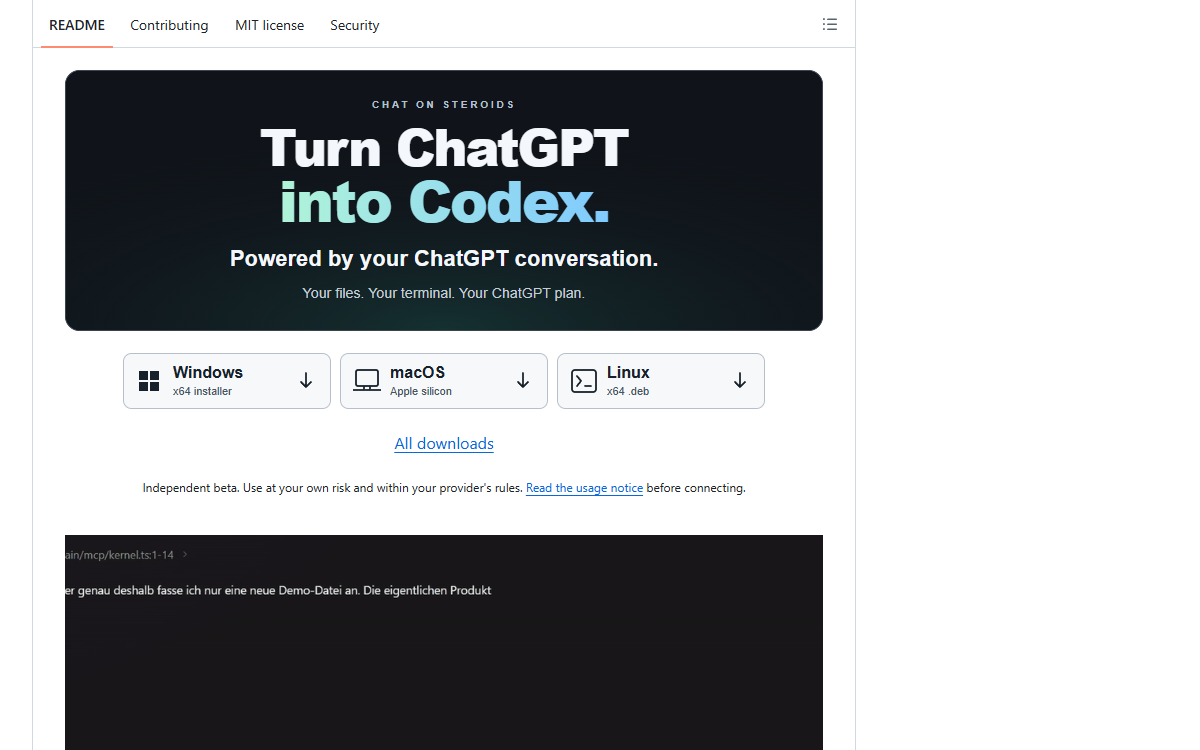
An Electron workspace built around ChatGPT rather than a coding agent of its own. It runs a local MCP listener and exposes it to the user’s own ChatGPT conversation through a tunnel, so the model can read and edit files inside approved folders, run commands, keep terminals open and drive the desktop — while a companion Chrome extension observes and automates the ChatGPT page itself, typing, sending and recording the turns. Workers are further ChatGPT chats that the app reuses for delegated jobs; Goal continues unfinished work and Loop keeps pushing inside the same brief; Compact & Resume moves one local session from an old conversation to a new one when it grows too long, with the worker history attached. The app is the authority on what a local tool did, and the extension never executes it. Windows 10 and 11, macOS 13 or newer and desktop Linux are supported, the licence is MIT, and the README calls the project an independent beta that is not affiliated with or endorsed by OpenAI, with local tools bounded by the folders and capabilities the user approves.
Who built itThe repository is owned by a second account, totec448-spec, and the work is split between them: Maximapple has 569 of the 876 commits and the owner account 159, together 730, while commit author names read Maxim on 571 of them. Neither account gives a real name anywhere in the material. Beyond them the contributor list holds 27 names, led by Haz4rdovisk with 31, ayhanmalkoc with 16 and hhh2210 with 15.
How it is put together
The parts · 6Four cooperating planes with one owner per fact. Core, Desktop and Plugins are three logical MCP surfaces behind a single local listener, each addressed by a secret path and checked against a live permission and a caller proof; the browser bridge is a separate loopback service with its own authentication; the optional control API is a third listener for a trusted local caller, and even then it only projects state or calls owners that already exist. The main process owns the truth about what a tool did, the extension only observes the page, and the renderer reaches neither filesystem, command nor secret — it gets a fixed preload API. The system is meant to be debugged by identity rather than by symptom: the agent map lists, per boundary, the identity that must survive a call — an approved root plus canonical real path, a request id, request id to conversation id to session epoch, conversation plus Chrome document id plus navigation epoch — and says that when four features break together the reader should follow one identity through those boundaries and repair the first wrong fact, not the last screen that showed it. Lifetimes follow the same rule: every store is declared with what it survives and what it cannot prove, and anything that must outlive the process is written before it is relied on.
- src/main/
- One hundred and forty-nine files and 3.28 MB, holding the largest file under
src/,bridge.tsat 537,795 bytes, besideagents.ts(226,494) andgoal.ts(148,955);session/wherestore.ts(191,166) andrecorder.ts(132,649) keep the durable identity;mcp/withtools-core.ts(116,939),kernel.ts(79,131) and separate browser, desktop and plugin surfaces; anddurable.ts. - extension/
- Fourteen files and 1.37 MB:
content.jsat 678,238 bytes,chatgpt-dom.jsat 161,384 and the 45,343-byte browser control in the isolated world,fiber.jsat 144,035 andusage.jsat 25,547 in the page world,background.jsat 239,061 as the suspending service worker, a 1,784-bytemanifest.json, and eight_localesdirectories of 38 to 48 KB each. - src/renderer/ and src/preload/
- Ninety files and 4.79 MB for the workspace itself:
chat.tsat 299,278 bytes,main.tsat 95,694, a 100,995-byteindex.htmland a 206,463-byte stylesheet, a 79,468-byte file panel, ten locale files of 142 to 180 KB each, the pet overlay, and a 23,899-byte preload that is the renderer’s only door to the main process. - test/
- The largest code directory by bytes: 283 files and 6,420 KB, with single test files at 1,037,734 bytes (
content-script.test.ts), 740,223 (bridge.test.ts), 271,784 (renderer-timeline.test.ts) and 203,385 (session.test.ts), plus parity suites that hold the reimplemented Codex patch, exec and image tools to the behaviour they came from. - docs/ and AGENTS.md
- One hundred and one documents and 742 KB under
docs/, next to a 303,241-characterAGENTS.md, a 146,821-character change log and a 34,531-character contributor wall. The documents are mostly dated working notes — some seventy worklogs, four bug audits, two bug hunts, a 29,954-byte study of ChatGPT turn signals, anddocs/pet/, 136 files and 44 MB of sprite batches and animation frames. - .github/ and packaging
- Fourteen workflows and 43 KB — a 19,312-byte release pipeline, a 7,140-byte publish job, continuous integration, CodeQL, verify-release, pr-triage, pr-checklist, needs-info, waiting-prs, similar-issues, a weekly digest and a welcome — with three installed git hooks, 83 build and verification scripts, an 83,126-byte Swift desktop helper, and a 10.5 MB third-party notices file.
Choices, and what they beat
Ride the user’s own ChatGPT conversation through a tunnel over calling a model API or invoking Codex directly
The README states it as the product’s premise — “Uses your ChatGPT conversation rather than invoking Codex directly” — and adds that ChatGPT Work and Codex share usage limits, so the account’s model availability and context limits still apply. Local capability is attached to a conversation the user already has, through an MCP listener reached over a tunnel.
A separate loopback bridge with its own authentication over one MCP listener that also carries the browser channel
The agent map counts four planes and gives the browser bridge separate authentication from the three MCP surfaces, each of which is addressed by a secret path and checked against a live permission. Model-facing tool calls and page orchestration therefore have different proofs and different failure modes, which is what makes the browser half restartable without touching the tool half.
The extension observes and orchestrates, and never executes a tool over letting the page run the local call it asked for
Stated in the agent map as a rule: the extension “never executes the model’s local tool”, and the main process is authoritative about what a local tool actually did. A page can be reloaded or navigated at any moment, so a result recorded there could not be trusted as evidence.
Write state where a crash cannot lose it over holding the queue and the session in memory
The outbox freezes an input before delivery, the session store and named state files are what survive a restart, and the extension keeps its journal, tab registry and command acknowledgements in a store that outlives worker suspension. The same document is equally explicit about what each of those stores cannot prove, so a restart is never mistaken for a live page.
Pin Electron exactly and keep it out of automatic updates over accepting the grouped dependency bump
The third-party notices and the native licence documentation name the exact Electron source tag, and a packaging test proves the shipped runners use those bytes, so an automatically bumped version would fail verification on every platform even if it built. Dependabot now skips Electron, and the same reasoning was applied earlier to the native image packages: they are upgraded by hand together with the licence review.
Read fromAGENTS.md — the 12,000-character opening of a 303,241-character file, covering the product description, the normal user path, the feature vocabulary, the runtime model with its four planes, the identity-per-boundary table and the storage-lifetime table — plus README.md in full (7,608 characters), the thirty issues and pull requests with their comment threads, the release and tag lists, the commit and contributor breakdowns, and the complete 1,035-file tree with per-file sizes and the directory summary.
Build log
6 stages- 01
Five weeks, 876 commits and twenty releases
The repository was created on 2026-08-22 and its oldest commit is Chat On Steroids 2.0.0 on 2026-08-24; the newest is a merge on 2026-10-01. Between those dates sit 876 commits in 39 days — 55 in August, 813 in September, 8 in the first hours of October — and 20 releases, from
v2.0.2on 2026-08-26 tov2.1.22on 2026-09-30, with a 21st prepared in an open pull request titled Release 2.1.23. The version numbers are the least interesting part of that list.2.0.6is titled “I am exhausted.”;2.1.13is titled “i am very sad. openai theatend to ban my account for whatever reason. anthropic support blocks me. money tight.”;2.1.14is “Death to Anthropic and OpenAI. Join the resistance”;v2.0.9is “they nerfed astra”,v2.0.8“Darkex by dark tibo”, and two releases two weeks apart are both titled “6 sol in 2 weeks”. The complaints were committed as evidence:docs/images/holdsopenai-account-warning-2026-09.png,openai-chatgpt-warning-2026-09.pngandanthropic-support-reply-2026-09.png. Around the same repository on 2026-10-01: 4,217 stars, 560 forks, 12 watchers, 15 open issues, 75,191 KB of metadata size, and a change log that has grown to 146,821 characters. - 02
The way in is MCP through a tunnel, not the API
The README gives setup as four steps: install the app and approve a project folder under Settings, then Workspace; connect Core under Settings, then Setup, and add it in ChatGPT under Plugins, then Add, then Create MCP App; load the companion extension unpacked and let it pair; then choose a model and send. What that hides is in the project’s own agent map, which counts four cooperating planes: Core, Desktop and Plugins are three logical MCP surfaces on one local MCP listener, each reached by a secret path and checked against a live permission and a caller proof, while the browser bridge is a separate loopback service with its own authentication and an optional local control API is a third listener for a trusted local caller. The transport is a tunnel client that the build fetches, with
src/main/tunnel/on the app side. The README states the reason: “Uses your ChatGPT conversation rather than invoking Codex directly”, with the note that ChatGPT Work and Codex share usage limits, so the plan, model availability and context limits still apply. Several releases are about this link alone —2.1.19is “The browser connects on its own again”,2.1.18“Recommended skills install again” — and an issue opened on 2026-10-01 shows the extension panel reporting the app connected on port 8769 while the worker it had just spawned still had no local tools. - 03
The extension is the half that touches the page
The companion is a Manifest V3 extension of fourteen files and about 1.4 MB, and it is where the ChatGPT page is actually read and written:
content.jsat 678,238 bytes andchatgpt-dom.jsat 161,384 run in the isolated world,fiber.js(144,035) andusage.js(25,547) run in the page’s own world, andbackground.js(239,061) is the suspending service worker holding the journal, the tab and document registry, the claims and the acknowledgements. The agent map is explicit that the extension “never executes the model’s local tool”, and it sets an economy for the browser: reuse an eligible document, let one operation own one elected tab across navigation and worker suspension, and treat a settled app-owned page as reusable after two minutes without work and closable after five, with pins and recent user access vetoing both. That the page world matters is not theoretical: when the 404 detection in #851 was reviewed, the note was thatusage.jslives there, so open ChatGPT tabs need one reload after updating. The extension ships eight locales; the app ships ten more plus English, which its own issue #855 counts as eleven languages. Release2.1.17advertises “an extension that updates itself”, with amanifest.jsonof 1,784 bytes carrying the version the app checks. - 04
Durable means written down before it is needed
Work that outlives a process has to be on disk, and the agent map says where. The clearest case is the queue: the app freezes an input in its durable outbox before delivery, which is why “queued”, “put into the composer” and “ChatGPT accepted it” are three different facts rather than one optimistic status. The document then states, per store, what it survives and cannot prove —
sessions/and namedstate/files survive an app restart but cannot prove an old page is running;storage.localsurvives a browser restart and holds pairing intent and command acknowledgements;storage.sessionsurvives worker suspension, enough for the journal and the tab registry; content-script memory survives one document. The local session is the durable identity and the ChatGPT conversation is the replaceable front end, whose id is explicitly not the session id — which is what lets Compact & Resume move the same session from chat A to chat B. Waiting chats and sleeping workers “retain their durable history and identity, not an indefinite browser tab”, and recovery helps only work the app can still prove it owes. There is asrc/main/durable.tsof 7,973 bytes with a 6,678-byte test, and the subtle part is a boundary: closing a chat’s tab pauses automatic repair, and #853 excepted an explicit, user-pressed Compact & resume, because pressing it is the user coming back. - 05
Permissions: approved folders and a window the model may not touch
Access is granted per folder and per capability: a fresh install enables the Core capabilities and two workers, Windows installs enable Desktop permissions as well, and shell commands run with the user’s normal privileges. The boundaries are settled against the real machine rather than argued. Issue #863 records the mismatch — on macOS the backend runs inside the app and skips its own process, so a window listing with the app’s own name returned 0 of 9 windows while the app window was open, while on Windows the helper is a separate PowerShell process and CoS’s own windows were listed, including the window holding CoS’s own permission switches. The fix passes the app’s process id to the helper. Issue #844 asked for WSL projects, and the answer was narrow: an existing folder under a local distribution may be approved through a distribution-hosted UNC path, arbitrary network hosts stay refused, UNC input outside an approved root is refused before any lookup, and only the distribution name is case-folded, since folding all of Windows would merge Linux folders that differ only in case. When #851 began watching a failed resume, the condition attached in review was that only the exact same-origin request is observed — its conversation id and HTTP status, “never headers, cookies or content” — fenced to one request, document, conversation, question and turn.
- 06
What the community round fixed, and what the maintainer retracted
The thirty issues and pull requests in the report are the newest thirty, and all fall inside eleven hours on 2026-09-30 and 2026-10-01 — one working night. Most of the fixes come from outside:
AcureroAdrianfiled the reports #844 to #847 and then the pull requests #848, #850 and #851 that answer them. Review is specific and about cost. On #849 the maintainer accepted the rule but objected thaterrors()runs on every recorder tick and walks up to eight ancestors readinginnerTextfor every button on the page, while the sidebar alone can hold hundreds of them; the contributor added a pre-filter and a test asserting zeroinnerTextreads for 300 sidebar buttons, with 894 tests passing. Asked for a Discord, the answer in #864 was that there is not one and there are no plans for one — GitHub is the place, with rules a workflow restates for first-time contributors: link the issue, one topic per pull request, a test that fails without your change, before-and-after screenshots for interface changes. That thread holds the admission worth keeping: after suggesting a new chat to a user, the maintainer wrote “starting a new chat is not the real fix. Sorry for that suggestion.” Live testing is shown rather than claimed: #860 records lowering the auto-compaction threshold to 10,000 tokens and restoring it, so compaction was found six minutes late after a turn ended.
Adjacent records
All records →No. 109
Whiteboard
A desktop app that puts an agent and a person on the same canvas: the agent draws the review — sequence diagrams, entity relationships, code peeks pinned to specific commits — and every shape on that canvas links back to the code it was drawn from.
No. 091
Lody
A workspace where a team shares the coding agents it already runs: connect a machine, bring Claude Code, Codex, Kimi or any other agent that speaks the protocol, and dispatch work from desktop, phone, web or terminal while sessions delegate to each other and the code stays on the machine its owner connected.
No. 084
Zeron
A Rust desktop app that runs the coding agents you already use — Claude Code, Codex, Cursor, Devin, Grok, Hermes, Pi and Antigravity — on your own machine, with no account required, and syncs the sessions to your other devices only if you sign in.