ComfyUI
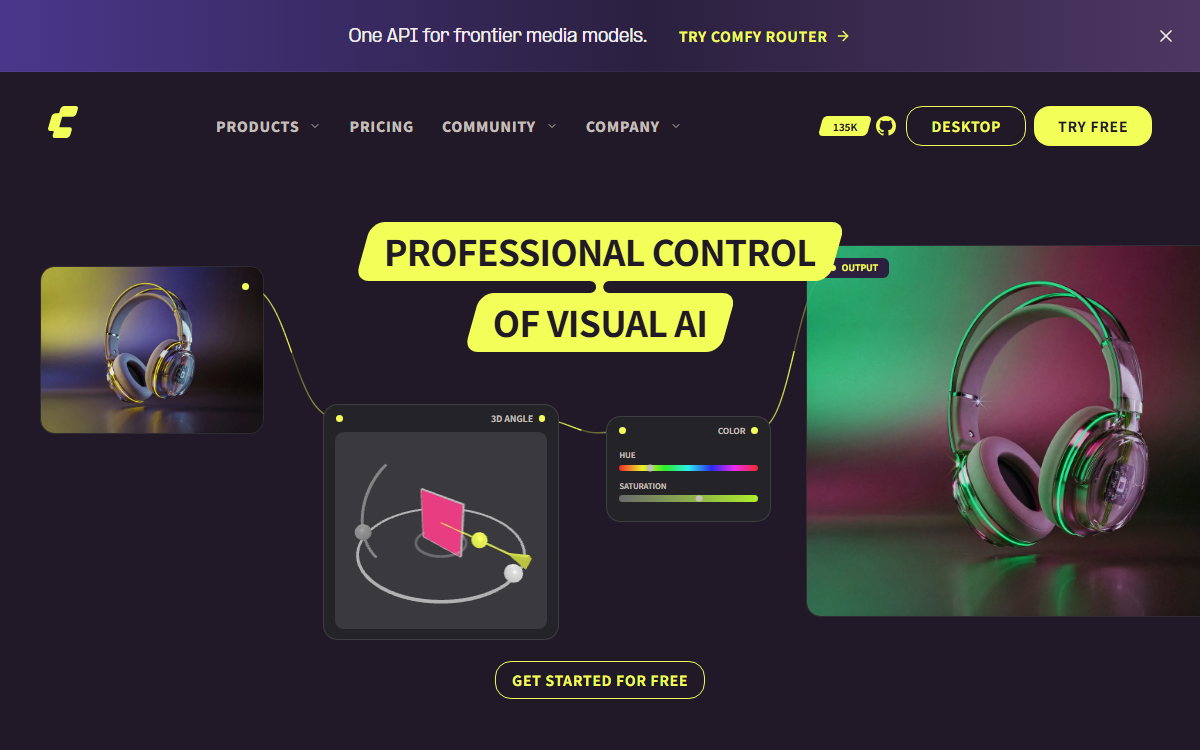
Runs diffusion models from a node graph: connect loading, prompting, sampling, decoding and saving, then run the graph.
What it is
A graph interface and backend for diffusion models: wire the steps together on a canvas, and the finished workflow is a JSON file that can be versioned and shared. One developer started it in January 2023 with no launch announcement; it is now the GPL-3.0 core of a company that has raised $47M.
Who built itYannik Marek built the first version of ComfyUI alone in January 2023, in a couple of weeks, as an experiment with Stable Diffusion; he came to it not from machine learning but as a C++ programmer working in his father’s dental implant factory. He published as `comfyanonymous`, an account with no name, photograph or bio, and his real name appears in the funding post of 24 April 2026 that calls him ComfyUI’s cofounder and creator, and in the fxguide podcast the following month. The repository has since moved from that account to the Comfy-Org organisation, created in April 2024.
Build log
6 stages- 01
Three start dates, no launch
The first commit, “Initial commit.”, is dated 2023-01-03; the GitHub API returns a repository `created_at` of 2023-01-17; the earliest public record is a Hacker News post on 2023-01-27 with 4 points and 1 comment. The first two dates disagree by fourteen days. The project has no launch announcement and no launch blog post, so this record uses the earliest date on which it is documented as publicly visible.
- 02
Eighteen months before the first version number
The first entry in GitHub Releases is the tag `latest`, a standalone portable Windows build published 2023-03-13. The first semantic version was v0.0.1 on 2024-07-12 — 487 days after that build and about eighteen months after the repository was created. Commits accumulated the whole time; the repository passed 6,025 commits by September 2026.
- 03
Custom nodes become the distribution
The project spread through community-written custom nodes rather than through releases. ComfyUI-Manager, written by Dr.Lt.Data (`ltdrdata`), installed those nodes and repaired their dependencies, and on 2025-03-28 it moved into the Comfy-Org GitHub organisation with its author staying on it; it remains a separate repository. The company’s own figures in its April 2026 funding post are 60,000+ community-built nodes, 4 million users and 150,000+ daily downloads.
- 04
Desktop V1, a new interface, a node registry
On 2024-10-21 the project released ComfyUI V1: packaged desktop applications for Windows, macOS and Linux (200MB, code-signed, auto-updating), a new default interface, and the Comfy Node Registry, which the announcement compared to NPM. The release was invitation-only — “We are releasing this in closed beta right now. Please sign up for the waitlist” — with a commitment to open the code when the open beta began. The same post put the original interface into maintenance mode.
- 05
Off the creator’s account, into the organisation
On 2025-12-29 the project announced that the repository would move from `comfyanonymous` to the Comfy-Org organisation, with a target date of 2026-01-06; the old address still redirects. The post gives three reasons — collaboration, security, and AI and tooling — and states that for a long time a single person reviewed code quality, alongside a commitment to “eventually setup longterm open governance structure for the ownership of the project”.
- 06
$47M raised, 135,198 stars
On 2026-04-24 the company announced $30M of new funding at a $500M valuation, bringing the total to $47M, led by Craft with Pace Capital, Chemistry and TruArrow participating. On 2026-09-23 it launched OpenRouter for generative media. At the 2026-09-27 snapshot the repository had 135,198 stars, 16,017 forks, 352 contributors and 4,982 open issues, with a commit that day and v0.37.0 released 2026-09-21. The repository counts 157 releases, and the semantic-version sequence starts at v0.0.1 in July 2024.
Adjacent records
All records →No. 039
classic-vibe-mac
Write C in a browser tab, press Build & Run, and a System 7 Macintosh boots with your freshly compiled 68k application sitting on its desktop.
No. 038
VibeRave
A fork of Strudel that lets you hold a key, say a genre out loud, and have the music change on the next bar without the beat ever stopping.
No. 034
N.O.R.A.Core
A single-author AI companion with two brains, an encrypted diary of its own, and 98 commits signed in its own name.