CrewAI
Agents get a role, a goal and a backstory; a crew runs several of them on one task.
What it is
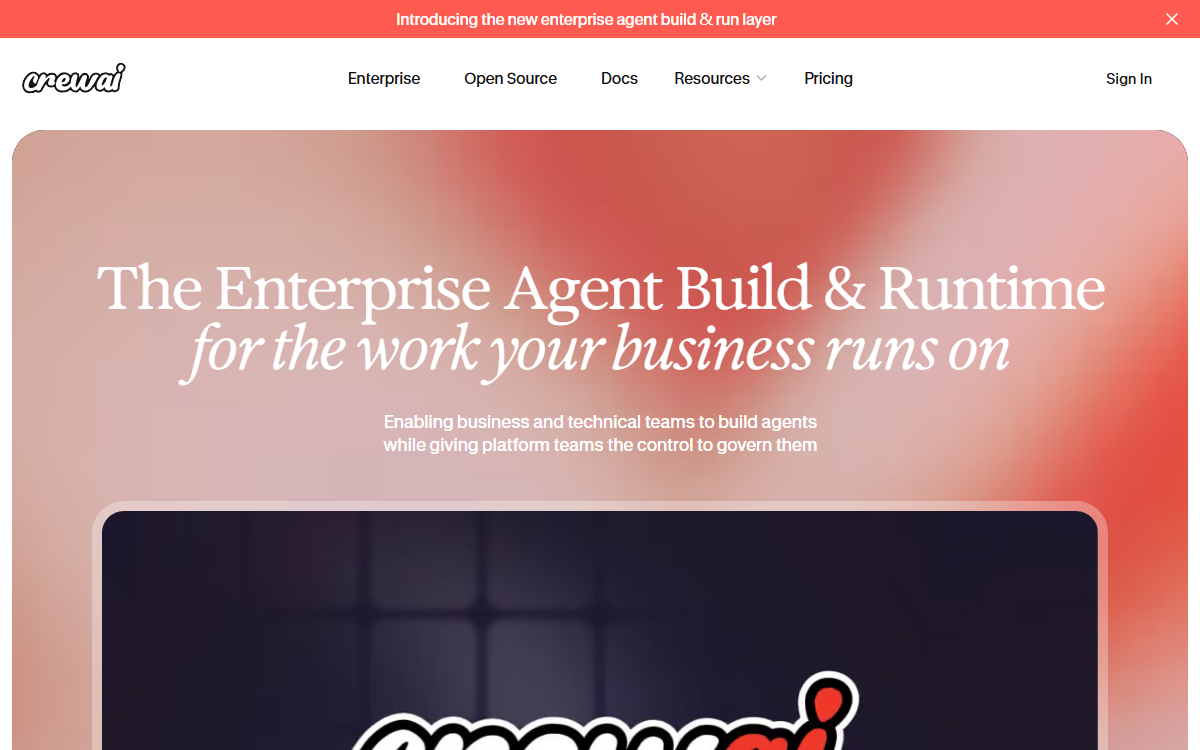
A Python framework that splits a job across agents carrying roles, goals and backstories instead of one long prompt chain. The licence is MIT with no addendum, and the framework is a separate thing from the paid platform the same company sells: CrewAI AMP, a managed deployment, observability, governance, security and enterprise support layer around it.
Who built itJoão Moura was director of AI engineering at Clearbit when he started writing agents for his own use, and the framework grew out of that rather than out of a product plan. He is CEO of crewAI, Inc., the company founded in January 2024 with Rob Bailey as COO; the framework is still MIT-licensed and still separate from the paid platform the company sells.
Build log
6 stages- 01
The agents he was building for himself
João Moura started writing agents while he was director of AI engineering at Clearbit and found the options thin: “I was trying to build Agents myself. I was struggling with it, because back then, there were not that many options.” His first prototype was a set of agents that wrote LinkedIn content, which by his account brought in as many as 600 inbound leads a day. What he took from it was a system question rather than a prompting one: “I wanted to automate my life away. [But] I don’t want to replicate the same things over and over. So how do I create a system? How do I create tech that allows me to reuse as much of this as I can?”
- 02
First commit, first release, two empty README sections
The repository was created on 2023-10-27 and the first commit landed two days later: “first stab at early concepts”, adding crewai/agent.py, crewai/crew.py, crewai/prompts.py and tests. The README that shipped with it held design notes rather than documentation — the conventions to keep (roles, tools, how agents interact, how much guidance to give) and the two reference points it named, AutoGen and ChatDev. AutoGen could run conversational agents autonomously but had no concept of process; ChatDev had processes but was stiff and not meant for production. Two sections of that README, “Why?” and “How?”, were left empty. Version 0.1.0 went to PyPI on 2023-11-14 and imported PromptTemplate from langchain.prompts; the first Hacker News thread, “Company Spotlight: CrewAI”, appeared on 2023-12-21 and scored 1 point.
- 03
From a personal repository to a company organisation
The company was founded in January 2024, with Moura as CEO and Rob Bailey as COO, and by the account given to Insight Partners it had 150 enterprise customers within six months. The GitHub organisation crewAIInc was created on 2024-05-23, and the repository moved into it from Moura’s personal account — the old joaomdmoura/crewAI address still redirects there.
- 04
Removing LangChain and rebuilding the executor
PR #1322, “Removing LangChain and Rebuilding Executor”, merged on 2024-09-16 with Moura as author and 177 files changed. Its description says the team had been overriding the Agent Executor for long enough and needed finer control, so the refactor removed langchain as a dependency while still supporting its tools. A follow-up, PR #1654 “Feat/remove langchain”, merged on 2024-11-26, and the pyproject.toml in the repository no longer lists LangChain.
- 05
A Series A, and a paid platform beside the framework
Reuters reported the 2024 raise as a $12 million Series A led by Insight Partners, alongside a $4 million seed and a $2 million pre-seed, both led by Boldstart Ventures — $18 million for the year. The company’s own release of 2024-10-22 states $18 million in total funding, names Blitzscaling Ventures, Craft Ventures and Earl Grey Capital among the investors, and reports more than 10 million agents a month in use at close to half the Fortune 500; SiliconANGLE adds Andrew Ng and Dharmesh Shah to that list, and the company blog also names Amjad Masad. The paid product is CrewAI AMP: a free Basic tier with the visual editor, an AI copilot, GitHub integration and 50 workflow executions a month, and an Enterprise tier quoted per customer that adds SSO, RBAC, workload identity, PII masking and policy controls, deployable in CrewAI’s cloud, a customer VPC or the customer’s own infrastructure.
- 06
1.0, and a licence that did not change
Version 1.0 was published on 2025-10-20, with a post signed by Moura reporting 1.4 billion agentic automations, 40,000 GitHub stars, 5,200 forks, 1.8 million downloads a month, 115 open-source releases, and use at 60% of the Fortune 500; the website now says 65%. The licence is still MIT with no addendum — the only edit to it was the copyright line, which read “The Python Packaging Authority” until a commit on 2025-03-09 changed it to crewAI, Inc. On 2026-09-28 the repository showed 59,111 stars, 8,585 forks, 340 contributors and 506 open issues, with 236 releases and 1.15.22 published on 2026-09-16.
Adjacent records
All records →No. 018
Cline
An open-source coding agent that reads files, runs terminal commands and edits across a repository.
No. 006
Dify
A visual workspace for building agentic workflows and RAG pipelines, run from Docker or from the vendor’s cloud.
No. 024
Codex CLI
OpenAI’s coding agent for the terminal, written in Rust after a rewrite from TypeScript.