Forbric
A Minecraft mod loader that runs Fabric, Forge and NeoForge mods in the same instance.
What it is
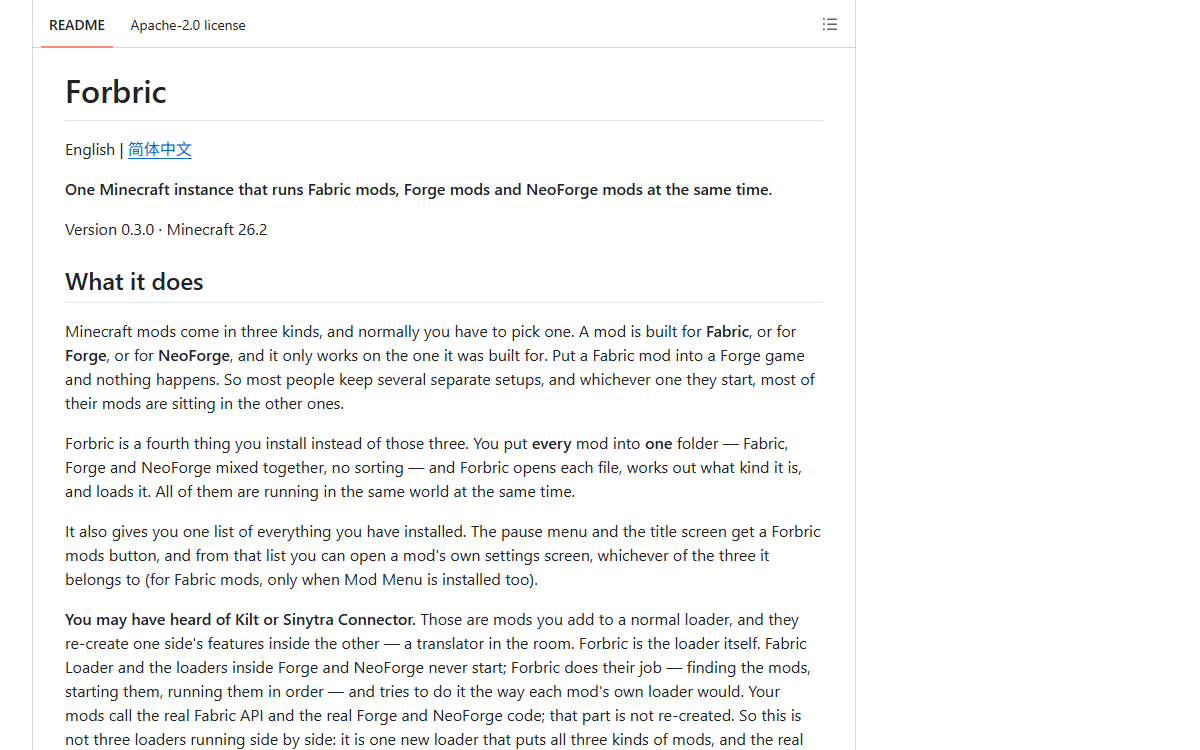
A mod is built for one of three loaders, and normally you install one of them and the rest of your mods sit in a different setup. Forbric is a fourth thing you install instead: Fabric, Forge and NeoForge mods all go into one mods folder, mixed together, and it works out what each file is and loads it. It is not a translator bolted onto a normal loader. Fabric Loader and the loaders inside Forge and NeoForge never start; Forbric does their job, and mods still call the real Fabric API and the real Forge and NeoForge classes. The README is equally direct about what it is not: Sinytra Connector is mature and Forbric is not, so if Connector already runs the mods you want, use Connector.
Who built itThe repository is one person’s. 1,076 of its 1,105 commits come from the Ray-T-r account, under two git names (Jerry and RayT); 28 come from a separate account called claude, and one from a third person. The same author posted the project to Bilibili, where the video has 411,541 plays.
How it is put together
The parts · 6The loaders are reimplemented, not bridged. Fabric Loader and the loaders inside Forge and NeoForge never start; Forbric does class loading, mod discovery, load order, the lifecycle, the Mixin service and Fabric Loader’s own API, whose types it carries and implements. The game underneath is one merged jar, built by the installer from both Forge families’ patches. Where MinecraftForge and NeoForge patched the same method, roughly a thousand of them, only one version could be kept, and NeoForge’s was kept in all but five. An event whose call was lost that way reaches a listener only if Forbric re-emits it. Mixins are applied to the merged code with the mod’s own configs relaxed, so an injector whose target is missing does nothing and the game stays up, and a mixin whose targets have all moved is dropped, not half-applied.
- forbric-kernel
- What the installer installs, and where the current work is: the loader reimplementation, the merge tools and the tests.
- forbric-loader
- The first generation of the loader, kept because the kernel grew out of it. Building it from source needs
./bootstrap.sh; the current development workflow does not. - The two installers
- A kernel installer jar plus a
.batfor Windows and a.commandfor macOS, so a double-click works on machines where.jarfiles are associated with something that only flashes a window. - tools/
- The development entry points, including a Python script that prepares the dependencies, builds and launches a client or a server from the current source.
- The documents
README.mdfor readers,introduction.mdfor developers on boot order, mixins and event bridges,COMPATIBILITY_IMPLEMENTATION.mdat 114 KB, andMOD_TEST_FAILURES.mdlisting what fails and why.- The event bridges
- The part that keeps the merge from being silent: events whose call disappeared in favour of the other loader’s version are re-emitted to the listeners that expect them.
Choices, and the alternative
Reimplement the loaders over a Connector-style compatibility mod
The README draws the line itself: Kilt and Sinytra Connector are mods you add to a normal loader and they re-create one side’s features inside the other, while Forbric is the loader. Fabric Loader’s public API types are carried and implemented, with FabricMC’s copyright kept.
Keep NeoForge’s version of the methods both Forge families patched over keeping MinecraftForge’s
About a thousand methods were patched by both and only one version can survive. The README states the split: NeoForge’s in all but five, MinecraftForge’s in those five.
Relax mods’ mixin configs over failing the load
required: falseanddefaultRequire: 0are set for the mods, so an injector whose target is gone does nothing and the game keeps running, unless the mod setsrequireitself.Assemble the game on the reader’s machine over shipping a ready-made merged jar
Stated as a licensing boundary: the repository contains none of that code, it is fetched from Mojang’s, Forge’s and NeoForge’s own servers and merged locally.
Read fromREADME.md, introduction.md and the repository history of Ray-T-r/Minecraft-Forbric-mod-loader, read 2026-10-04.
Build log
4 stages- 01
Two months of commits, one person, and a model named in most of them
The repository holds 1,105 commits, dated from 2026-07-29 to 2026-10-04. 1,076 of them are from the Ray-T-r account, which appears under two git names; 28 are from an account called
claude, and one is from a third person. 958 commits carry a co-author trailer, and every one of those names a Claude model: Claude Opus 5.5 on 529, Claude Opus 5 on 359, and Claude Fable 5.1 on 70. The repository was created on GitHub on 2026-09-10, six weeks after the oldest commit in it, so the public history starts partway through the work rather than at the beginning of it. - 02
The video that carried it, and who made that too
The author posted the project to Bilibili on 2026-09-30 as a 1 minute 17 second video titled “我合并了3个mc模组加载器”. It has 411,541 plays, 68,204 likes and 32,364 favourites. The description carries the installation link and one further line: that the video itself was made by Claude Opus 5.5. The GitHub repository has 204 stars, so for this project the Chinese video was the distribution and the repository is where the work lives.
- 03
Tested by starting about three hundred mods, one at a time
The README states the method it used: three batches of about 100 random mods taken from Modrinth, popular and obscure, all three kinds, with the game started once per mod on its own. 80.5% loaded without errors on 0.2.0 and 89.0% on 0.3.0; 91.8% of the 0.3.0 run reached a world, and 79.1% had no part of the mod reported as not working. The README then says what the test does not cover, that it does not exercise each mod’s features and does not test mods together, and it names the four mods that worked on 0.2.0 and do not on 0.3.0. A green build is not the same as a working game either: continuous integration verifies the build and never launches Minecraft.
- 04
Nothing shipped that cannot be handed out
The repository contains no Minecraft, Forge or NeoForge code. The installer downloads those from their own servers and assembles a single merged game jar on the reader’s machine, which is why a first install needs about 730 MB of free disk and a connection, and why it takes minutes rather than unpacking an archive. Forbric itself is Apache-2.0, and the clean-room boundary between what it reimplements and what it carries is documented in
forbric-loader/CREDITS.mdandMAPPINGS.md.
What they would tell you
- The README writes down what it will not promise: about one mod in ten still fails on its own, and mods that each work alone can still clash when they are put together.
- Part of a mod can stop working without a crash. Forbric keeps the rest of the mod running and usually says so, but when a piece attaches and then behaves wrongly, neither Forbric nor its tests can tell.
- A known bug, documented rather than hidden: the NeoForge build of Sodium crashes at startup unless Fabric API is also installed, and so do the mods that depend on it.
- Start-up extensions are not supported at all. ModLauncher’s transformation services,
coremods.json, NeoForge’sClassProcessorProviderand custom mod or dependency locators are skipped without a warning today. - This is a research project at 0.3.0 with no support and no roadmap, and CI never launches the game, so a passing build says nothing about whether it starts.
Adjacent records
All records →No. 124
Lemmalog
A Rust Datalog engine that treats agent memory as a deductive database, not a bigger vector store: facts asserted at the extraction boundary, stratified rules deriving closures and temporal views, provenance back to the source episode on every derived fact, and views maintained one epoch at a time — served to Claude Code and Kimi CLI as twelve MCP tools.
No. 077
Engram
A learning engine that installs into a coding agent: a curriculum architect breaks a topic into a first-principles concept map, a tutor makes you predict, attempt and explain before it explains, a blind assessor grades your verbatim free recall and writes a receipt for every verdict, and a deterministic FSRS-4.5 core in one Python file decides when each concept comes back, with explorable HTML built only for the concepts whose content rewards manipulation.
No. 143
Jeff
A 0.8B open model that answers first and hands the query to a large model only when its own confidence falls below a threshold.