Open Interpreter
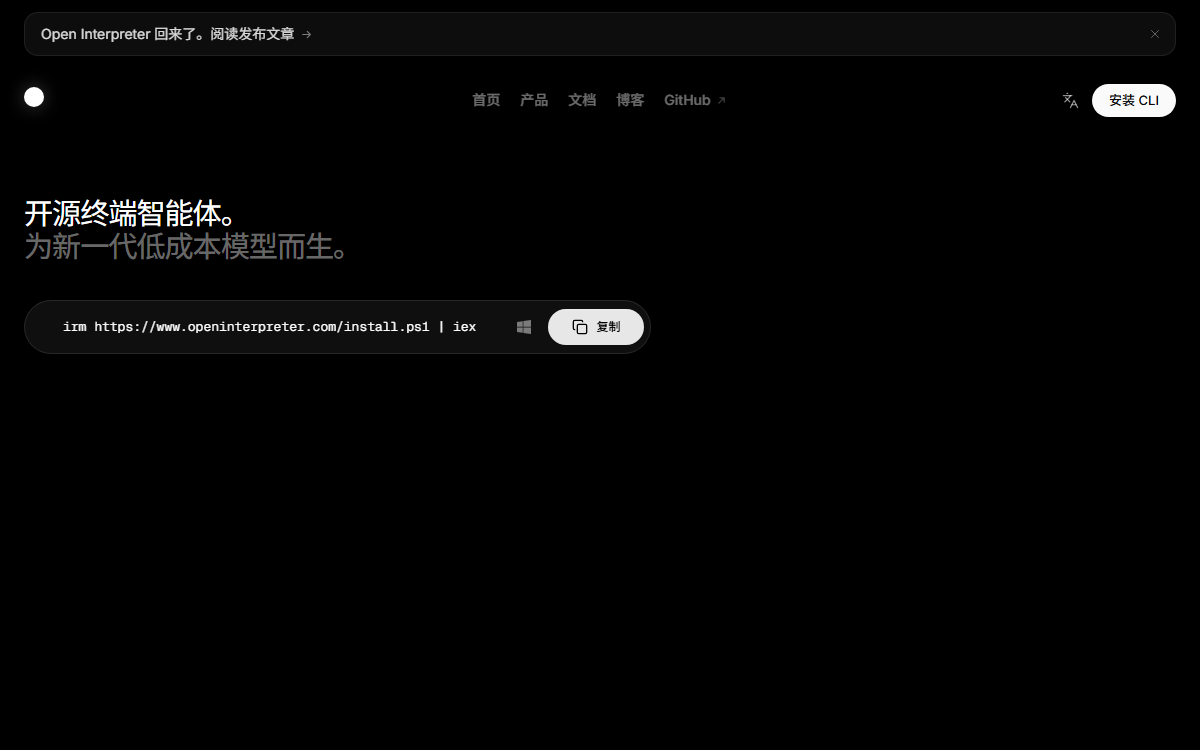
A terminal coding agent that started as a local alternative to OpenAI Code Interpreter and was rebuilt in 2026 as a Rust fork of Codex, aimed at open-weight models.
What it is
A terminal coding agent that writes and runs code on your machine. The 2023 Python version was an open, local answer to OpenAI’s Code Interpreter; the current repository is a Rust fork of OpenAI’s Codex built for low-cost open-weight models, and the original Python code lives on as a community fork.
Who built itKillian Lucas created Open Interpreter and published it on 14 July 2023 under his personal GitHub account: the repository and the first PyPI release were 50 minutes apart, and five versions went out that day. The project outgrew the account — it moved to an openinterpreter organisation in March 2024, the 2026 rewrite is a Rust fork of OpenAI’s Codex, and the original Python version is continued by two community maintainers.
Build log
6 stages- 01
Repository and first release, 50 minutes apart
The repository was created on 14 July 2023 at 07:10:44Z under Killian Lucas’s personal account, and version 0.0.1 was on PyPI at 08:00:45Z. Five versions went out that day, ending with 0.0.222 at 22:01:40Z. The description at the time was “OpenAI’s Code Interpreter in your terminal, running locally”; the earliest GitHub Release is v0.0.289 on 11 August 2023.
- 02
Two Hacker News appearances
A Show HN on 30 August 2023 titled “Open Interpreter – CodeLlama in your terminal, executing code” took 82 points and 21 comments. The highest-scoring thread came on 12 November 2023 with 117 points and 58 comments. The openinterpreter GitHub organisation was created on 12 March 2024 and the repository moved under it; PyPI records 130 versions for the Python line, running from 0.0.1 to 0.4.3 and never reaching 1.0.
- 03
The Python line stops at 0.4.3
The last Python release, v0.4.3, was published on 26 October 2024, and the sibling hardware project 01 was last pushed on 1 November 2024. The community fork endolith/open-interpreter was created on 13 November 2024. The next release from the main repository came 603 days later, and no public account of the gap is recorded.
- 04
Rebuilt as a Rust fork of Codex
The first Rust releases, rust-v0.0.16 and rust-v0.0.17, both landed on 20 June 2026. The README states that “Open Interpreter is a fork of OpenAI’s Codex”, and the blog says the project inherits Codex CLI’s terminal interface, app-server protocol and cross-platform sandbox; the repository carries several codex/* branches. Twenty-two rust-v0.0.x releases followed by 20 September 2026, still short of 1.0.
- 05
The licence changes, and the Python version is handed over
The rewrite ships under Apache-2.0, replacing the AGPL-3.0 of the Python line; the blog says the new Open Interpreter is released under the permissive Apache 2.0 licence. The README points readers looking for the original to the community-maintained fork, and the blog thanks the two maintainers who took it on, Anton (notnaton) and Endolith (deseculavalutent). The classic Python version stays AGPL-3.0, as do the organisation’s 01 and 01-app repositories.
- 06
Harness emulation, and the numbers since
The rewrite’s central claim is harness emulation: coding models are trained against a particular harness — tool behaviour, system instructions, context-compression workflow — so rather than one universal harness, the agent emulates the one each model saw, a Claude Code-like harness for Claude, the Codex harness for GPT, and provider-recommended harnesses for Kimi, Qwen and DeepSeek. A /harness command switches between claude-code, kimi-cli, qwen-code, deepseek-tui, swe-agent and minimal. The blog’s own Terminal-Bench 2.1 figures are 50 of 89 tasks for Kimi-K2.5 against 39 in OpenCode 1.15.7, and 53 against 42 for DeepSeek V4 Flash. At the collection date the repository showed 68,458 stars, 5,880 forks, 616 contributors and 70 releases, with its last commit on the collection day itself.
Adjacent records
All records →No. 029
realworld-vibe-coded
A full-stack RealWorld implementation whose real subject is the harness around it: thirty-two custom Roslyn analyzers, one build entry point, and hooks that stop an agent from doing the wrong thing.
No. 022
goose
A general-purpose AI agent that runs on your own machine, shipped as a desktop app, a CLI and an API, with extensions built on the Model Context Protocol.
No. 039
classic-vibe-mac
Write C in a browser tab, press Build & Run, and a System 7 Macintosh boots with your freshly compiled 68k application sitting on its desktop.