Open WebUI
A self-hosted chat interface that talks to Ollama and to any OpenAI-compatible API.
What it is
A self-hosted AI interface installed with `pip install open-webui` or a Docker image, with multi-user accounts, retrieval-augmented generation, voice and vision, and extensions written in Python. It was created as `ollama-webui` on 2023-10-06, renamed on 2024-02-17, and has changed licence twice since — the current one adds a branding clause that applies above fifty users.
Who built itTimothy Jaeryang Baek pushed Open WebUI’s first commit on 6 October 2023; the copyright sat in his own name until April 2025, when it moved to Open WebUI Inc., the company whose team page describes the group around him only as “a small core team” led by its creator and founder. His personal site states the intent: “an open, local, and decentralized AI interface”, which he frames as groundwork for humanity’s expansion into space.
Build log
6 stages- 01
Created as ollama-webui
The repository and the GitHub organisation named `ollama-webui` were both created on 2023-10-06, and the first commit, “Initial commit”, was pushed by `tjbck` — Tim Baek — the same day. His personal site states the goal behind the project: “a foundational technology” for “autonomy and resilience in humanity’s expansion into space”, with Open WebUI described as “an open, local, and decentralized AI interface”. The old address `ollama-webui/ollama-webui` now returns a 301 to repository id 701547123, which is the current repository.
- 02
Renamed, then onto Hacker News
The rename to `open-webui/open-webui` happened on 2024-02-17, the day pull request #765 was merged from a branch named `ollama-webui/rename`; branches merged after that date carry the `open-webui/` prefix. The project appeared on Hacker News on 2024-02-18 as “Open WebUI: ChatGPT-Style WebUI for Ollama”, with 29 points and 3 comments. The first GitHub release, v0.1.102, is dated 2024-02-23 and was created by `github-actions[bot]` with a body beginning “Automatically created new release”.
- 03
Licence change one: MIT to BSD-3-Clause
On 2025-01-10 `tjbck` committed `a76068d69c`, “Update LICENSE”, replacing MIT with BSD-3-Clause; the only file changed was `LICENSE`. `LICENSE_HISTORY` splits the code by commit: everything before `a76068d69c` is MIT, under “Copyright (c) 2023 Timothy Jaeryang Baek”.
- 04
Licence change two: a branding clause, and a CLA
On 2025-04-18 commit `60d84a3aae`, `chore: license "branding" clause`, replaced BSD-3-Clause with the custom “Open WebUI License”, whose copyright line reads “Copyright (c) 2023- Open WebUI Inc. [Created by Timothy Jaeryang Baek]”. Clauses 1–3 are BSD-3-Clause text; clause 4 forbids altering, removing, obscuring or replacing the “Open WebUI” branding in any deployment, except for deployments of fifty or fewer end users in a rolling thirty-day period, with specific prior written permission, or under an executed enterprise licence. The change shipped with v0.6.6 on 2025-05-05 — the official licence page notes that v0.6.5, released 2025-04-14, can still be forked “with zero restrictions” — and a Hacker News thread on 2025-05-06 titled “Open WebUI changed license from BSD-3 to Open WebUI license with CLA” drew 73 points and 59 comments. The contributor agreement grants Open WebUI Inc. “a perpetual, worldwide, irrevocable, royalty-free license, under copyright and patent, to use, modify, distribute, sublicense, and commercialize” contributions under any terms it chooses.
- 05
Release cadence and product shape
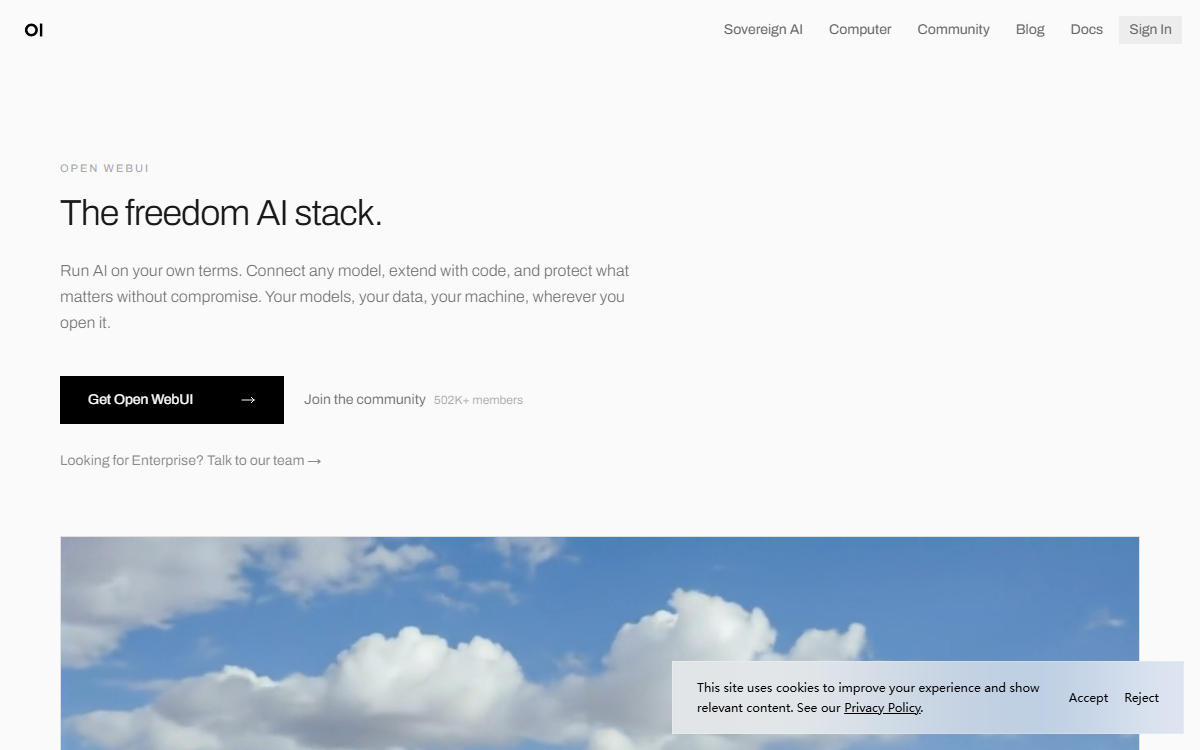
The repository has 171 releases: 79 in 2024, 61 in 2025 and 31 in 2026, running from v0.1.102 to v0.11.4 on 2026-09-21. Major-version dates include v0.2.0 (2024-06-02), v0.6.0 (2025-04-01), v0.7.0 (2026-01-09) and v0.11.0 (2026-07-27). The organisation now also publishes `pipelines`, `mcpo`, `desktop`, `open-terminal` and `terminals`, and the documentation describes three product shapes: the self-hosted version, a hosted cloud service and an enterprise edition. The site lists 400M+ downloads, 502K+ community members and 153K+ GitHub stars — the project’s own figures — and the two Docker tags are 1.66 GB (`:main`) and 176 MB (`:slim`).
- 06
Not an Ollama product
The documentation lists Ollama among the “Alternatives to Open WebUI”, alongside llama.cpp, LM Studio, Jan, AnythingLLM, LibreChat, Msty, Onyx, Dify, ChatGPT, Claude and Gemini, and the comparison page credits it: “Ollama is the project that made local AI click for millions of people, and Open WebUI wouldn’t be where it is without them.” At the 2026-09-28 snapshot the repository had 153,393 stars, 22,441 forks, 881 contributors and 285 open issues, with the last commit on 2026-09-21. Third-party company databases disagree with one another about the company’s headquarters, founding year, employee count and funding, and the company’s own site, blog and documentation carry no funding announcement.
Adjacent records
All records →No. 039
classic-vibe-mac
Write C in a browser tab, press Build & Run, and a System 7 Macintosh boots with your freshly compiled 68k application sitting on its desktop.
No. 031
MiroFish
A prediction engine that builds a parallel world of hundreds of AI agents out of a document you upload, then runs it forward to see what happens next.
No. 023
VibeFlow-P5
A p5.js particle sketch, a 356-byte Go file server and a hardened Docker image, published alongside a manifesto for vibe coding — with the conversation’s German left in the comments.