Codex CLI
OpenAI’s coding agent for the terminal, written in Rust after a rewrite from TypeScript.
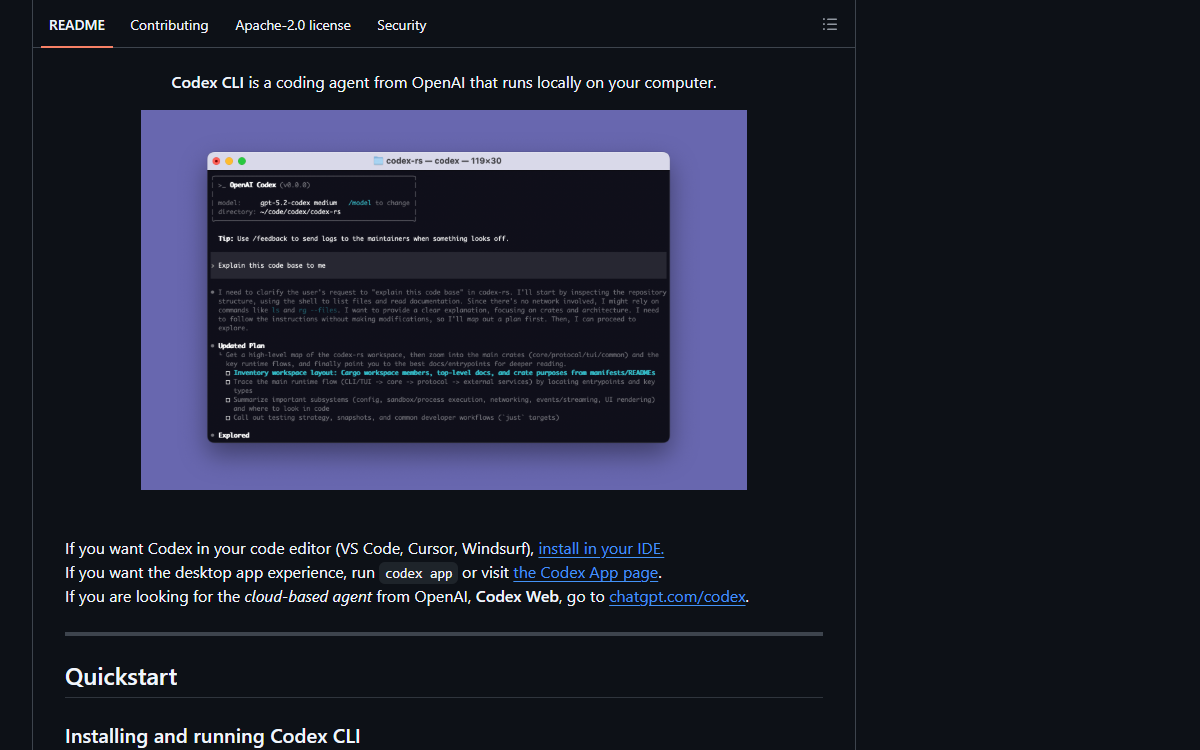
What it is
OpenAI’s terminal coding agent, released on 2025-04-16 alongside o3 and o4-mini and rewritten in Rust after an announcement on 2025-05-30. The repository holds 1,160 releases split between a stable and an alpha channel, and sign-in runs through a ChatGPT plan rather than an API key.
Who built itCodex CLI is an OpenAI product rather than an individual’s project: the repository sits in the `openai` organisation, its first commit is by Ilan Bigio, the contributor list runs to 631 accounts including anonymous ones, and the company has not published a team size — the Rust rewrite announcement routes enquiries to codex-maintainers@openai.com. That announcement was signed by an engineer posting as `fouad-openai`, Fouad Matin, who joined OpenAI in May 2024 from Indent, the access-control company he co-founded and led as CEO. Sign-in runs through a ChatGPT plan rather than an API key; the README says using an API key instead requires additional setup.
Build log
6 stages- 01
A repository on 2025-04-13, a public release on 2025-04-16
The repository was created on 2025-04-13, and the product was announced on 2025-04-16 alongside OpenAI’s o3 and o4-mini models. The npm package `@openai/codex` was created at 2025-04-16T17:04:25Z and published its first version, `0.1.4160940`, at that same timestamp; TechCrunch’s report, by Kyle Wiggers, is stamped 10:00 AM PDT on April 16, and the Hacker News thread that day drew 516 points and 289 comments. The earliest visible commit in the repository is dated 2025-04-19, three days after the public release, with the message `feat: /diff command to view git diff (#426)`. The repository shares its name with a 2021 OpenAI model; a Spanish-language outlet, Xataka, counts that model as a separate product that powered early versions of GitHub Copilot and is no longer operating.
- 02
The first version was TypeScript, Node.js and ink
The original implementation was TypeScript and Node.js, with the terminal interface rendered by the React-based `ink` library. OpenAI described the core of it as an “agentic” harness — calling the model in a loop — rather than the interface, which the rewrite announcement called easy to iterate on. Versions from that period carry build timestamps in the suffix, as in `0.1.4160940`. Installing it required Node v22 or newer, which the announcement describes as “frustrating or a blocker for some users”.
- 03
Going native: the Rust rewrite
On 2025-05-30 an OpenAI engineer posting as `fouad-openai` published GitHub Discussion #1174, “Codex CLI is Going Native”, announcing a rewrite in Rust. The announcement gives three reasons: a zero-dependency install, native security bindings (the project already shipped a Rust sandbox for Linux), and an extensible wire protocol so developers can extend the agent in other languages, with MCP support already in the Rust code. The migration plan was to keep merging bugfixes into the TypeScript implementation while the Rust version reached feature parity. A Hacker News thread on 2025-06-01 drew 151 points and 129 comments.
- 04
A stable release, then a release most weeks
The first stable Rust release, `rust-v0.2.0`, is dated 2025-06-30, a month after the rewrite announcement; the version numbers then ran v0.3.0 on 2025-07-08, v0.10.0 on 2025-07-24 and v0.11.0 on 2025-08-02. Monthly GitHub release counts run 2 in 2025-04, 21 in 2025-05, 52 in 2025-08, 63 in 2025-09, 92 in 2026-04, 84 in 2026-06, 82 in 2026-08 and 119 in 2026-09, the last an incomplete month with data to 2026-09-27. Across the repository there are 1,160 releases: 955 with `alpha` in the tag, 164 in a stable `x.y.z` form, and 41 others including vendored dependencies and helper tools; no tag contains `nightly`. The npm registry carries 5,008 versions, with dist-tags `latest` at 0.157.1, `alpha` at 0.158.0-alpha.15.3, and `beta` and `native` channels.
- 05
One CLI becomes four product shapes
The README now lists four ways to run Codex: the local CLI, an IDE extension for VS Code, Cursor and Windsurf, a desktop app started with `codex app`, and a cloud agent at Codex Web. Installation runs through a one-line script for macOS and Linux (`install.sh`) or Windows (`install.ps1`), `npm install -g @openai/codex`, `brew install --cask codex`, or a platform binary from GitHub Releases; the standalone installer downloads from `releases.openai.com/codex` by default and can be pointed at GitHub Releases with an environment variable. Billing runs through a ChatGPT account on the Plus, Pro, Business, Edu or Enterprise plans, and the README says that using an API key instead “requires additional setup”. The repository is Apache-2.0, with `LICENSE` and `NOTICE` files at the root.
- 06
A monorepo at 126,763 stars
The repository has become a monorepo: the root holds `codex-cli`, `codex-rs`, `sdk`, `docs`, `bazel` and `third_party` directories, and the build uses both Cargo and Bazel across 11,493 commits. As of 2026-09-27 the GitHub API reports 126,763 stars, 19,795 forks, 19,193 open issues and 631 contributors. The current stable release is `rust-v0.157.1` from 2026-09-26; the most recent commit, on 2026-09-27, fixes long symlink paths for Unix sockets (#48772).
Adjacent records
All records →No. 018
Cline
An open-source coding agent that reads files, runs terminal commands and edits across a repository.
No. 027
Gemini CLI
Google’s terminal agent for Gemini, Apache-2.0, with the unpaid tier handed to Antigravity CLI.
No. 029
realworld-vibe-coded
A full-stack RealWorld implementation whose real subject is the harness around it: thirty-two custom Roslyn analyzers, one build entry point, and hooks that stop an agent from doing the wrong thing.