Distilly
A skill that turns a person’s messages, documents and interviews into a reusable profile — their experience, judgement and way of working — and states plainly that a profile is not a clone of the person.
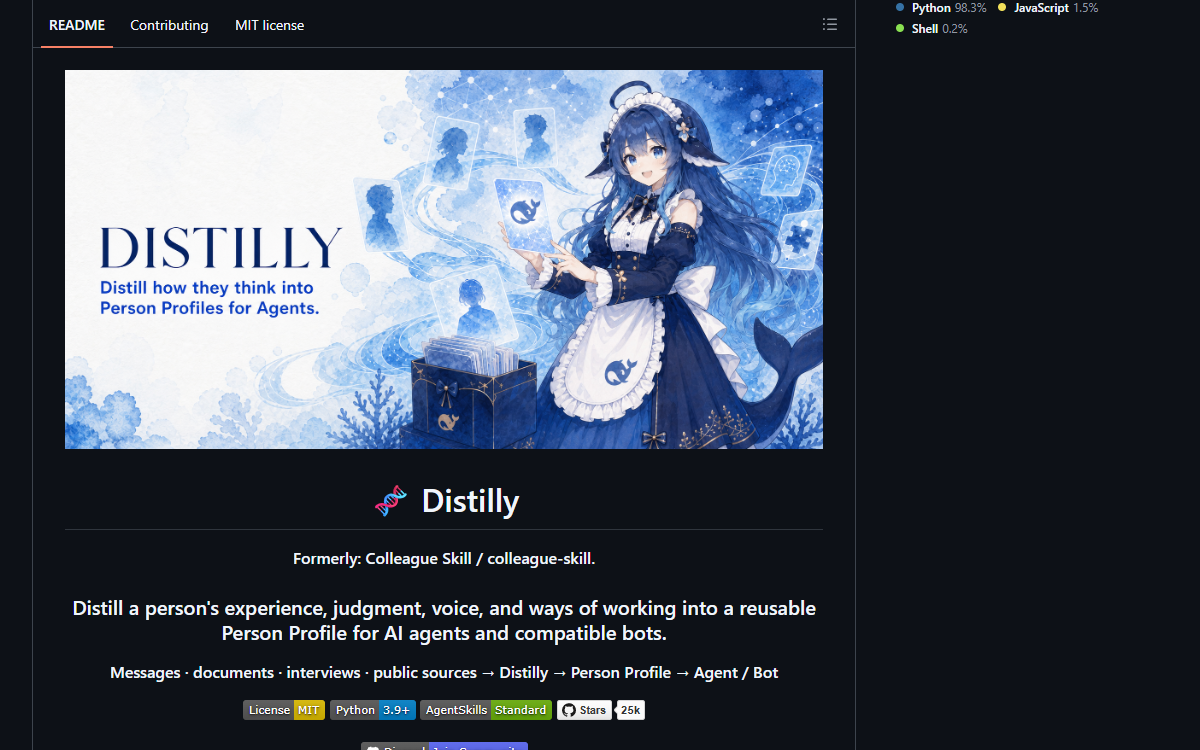
What it is
A creator skill that reads what you have — chat logs, documents, interviews, public material — and distils one person’s experience, judgement, voice and working methods into a portable profile that agents and bots can install. The output is packaged as an Agent Skill, so any host that speaks the protocol can use it. It advertises bindings for Claude Code, Codex, Hermes Agent, OpenClaw, OpenCode and DeepSeek Harness, ships in eight languages, and describes its own limit in the README rather than in a disclaimer: the profile is built from observable behaviour and does not claim to be the person.
Who built itCommits under the account titanwings, 134 of the 140, and also under the names zhoutianyi and Tianyi Zhou with an address at the University of Michigan, which is where 59 of the commits come from. The repository was renamed from colleague-skill to distilly, and the old name is kept in the description for search continuity.
Build log
8 stages- 01
The repository was renamed, and the old name is the one in circulation
What the gallery still lists as colleague-skill is now
titanwings/distilly, and the default branch isdot-skillrather than the usual pair. The project keeps the former name in its description explicitly — for search continuity — which is why this record is under the current name and why anyone following the old link should still arrive. The scale is substantial: 25,127 stars, 2,172 forks, 141 files, 18.8 megabytes, 67 open issues, and 140 commits all attached to linked accounts. The README is published in eight languages: English, Chinese, Spanish, German, Japanese, Russian, Portuguese and Korean. - 02
What it does
The input is material rather than a description: messages, documents, interviews and public sources. The output is what the project calls a Person Profile — experience, decision patterns, expression and ways of working — packaged as an Agent Skill so that any host speaking the protocol can install and invoke it. The README lists who this is for, and the list is more honest about the genre than most: a colleague who left and took their playbook with them, a mentor who graduated, a family member or an old friend you are drifting from, an author or thinker you will never meet, a fictional character, or yourself. Distilling a colleague is the trick that got attention; the README is careful to point out that colleagues are only one of the things people want to preserve.
- 03
It does not claim to be the person
The line that matters most is in the third paragraph: the profile is built from observable experience, decision patterns and expression, and the project does not claim to clone the person behind them. Every input is meant to be source-grounded, and the artefacts are described as profiles rather than as the people they are drawn from. This is the same instinct that the project it inspired later formalised as a fidelity scorecard, and it appears here first — in the repository that, by the account of the better-known successor, proved the idea was workable at all. For a category that invites overclaiming in every sentence, a stated boundary is the most valuable thing in the file.
- 04
Nineteen tags in a single day, each named for one change
The tag list records a hardening session better than any changelog. Nineteen of the twenty tags are dated the same day, and each is named for exactly one thing: fixes for splitter termination, byte-exact splitting, a seventeenth round, a ninth round, an eighth round, JSON rollback, the personas root, import integrity, a host key, harvest idempotence, canonicalisation of a harness home directory, and persona registration for one particular host; features for version rollback and for a floor on unverified hosts; and five snapshots taken before each binding, named for the state they preserve. Tagging the state before each risky change, then tagging the change, is a practice this archive has not seen elsewhere, and it makes the repository’s own history searchable by failure mode rather than by date.
- 05
The host list is a snapshot of the field
The bindings this project advertises are a fair picture of the multi-host agent landscape at the time of writing: Claude Code, Codex, Hermes Agent, OpenClaw, OpenCode, and DeepSeek Harness — the last of which this archive recorded as its forty-third entry, and which appears here as
dsh-bindingin a tag name and as the harness home directory in a canonicalisation fix. Two of the tag names also show what the work actually consists of: registering personas for one specific host, and handling another host’s key format. Supporting many hosts is not one abstraction but a series of small, host-shaped problems, and the tag list is where that shows up. - 06
The trailers name models, and they cluster in one month
Sixty-eight of the 140 commits carry a co-author trailer naming a model — Opus 4.6 on forty-six, Opus 4.7 on eleven, Sonnet 4.6 on seven — alongside a human co-author and one trailer that names Cursor. They are not spread evenly: April accounts for 72 of the 140 commits and most of the model attribution, while the recent work is the maintainer hardening host bindings in September. A repository whose AI-written phase is concentrated in one month is the exact shape that a short sampling window gets wrong, and it is worth recording as a property of the project rather than as a footnote: the history is layered, not uniform.
- 07
Four contributors, a Discord, and a citation block
The contributor list is short and mostly one person — 134 commits, then three, one and one from three others — but the project carries more community infrastructure than that ratio suggests: a Discord server, a contributing guide, eight translated READMEs maintained as the project changed names, and a citation section in the README, which is what a project does when it expects to be referenced in written work rather than only installed. Fifty-nine commits arrive under a university address, and the project reads like something built between research and product: careful about what it claims, thorough about what it reads, and packaged for people who will not read the source.
- 08
What the repository cannot tell you
There is one release, tagged as a demo and marked prerelease, published on the day the project opened; everything since is distributed by tag and by clone. Of the twenty tags, nineteen are from a single day. Sixty-seven issues are open and the last commit is about two and a half weeks older than this record. And the consent question that hangs over distilling a person — particularly a living colleague, partner or family member, which the README invites — is answered by narrowing the claim rather than by a policy: the output is a profile of observable behaviour, not the person. That distinction is honest and it is also load-bearing for the whole genre, and this repository is where it was first written down.
Adjacent records
All records →No. 055
Nuwa Skill
A skill that distils a person’s thinking — mental models, decision heuristics, the way they talk — into a reusable agent persona, and scores the result against a fidelity rubric before anyone else is allowed to use it.
No. 051
AI Job Search
A job-application framework that runs on your own machine: it scores postings against a profile you fill in, drafts a tailored CV and cover letter in LaTeX, compiles them, reads the rendered PDF back — and stops one step short of sending anything.
No. 048
gstack
Twenty-three specialist roles and eight power tools for Claude Code, all written as Markdown slash commands, plus the evaluation harness their author uses to decide whether any of it is working.