gpt-engineer
A command-line tool that turned a text prompt in an empty folder into a codebase, and which its own README now sends users away from.
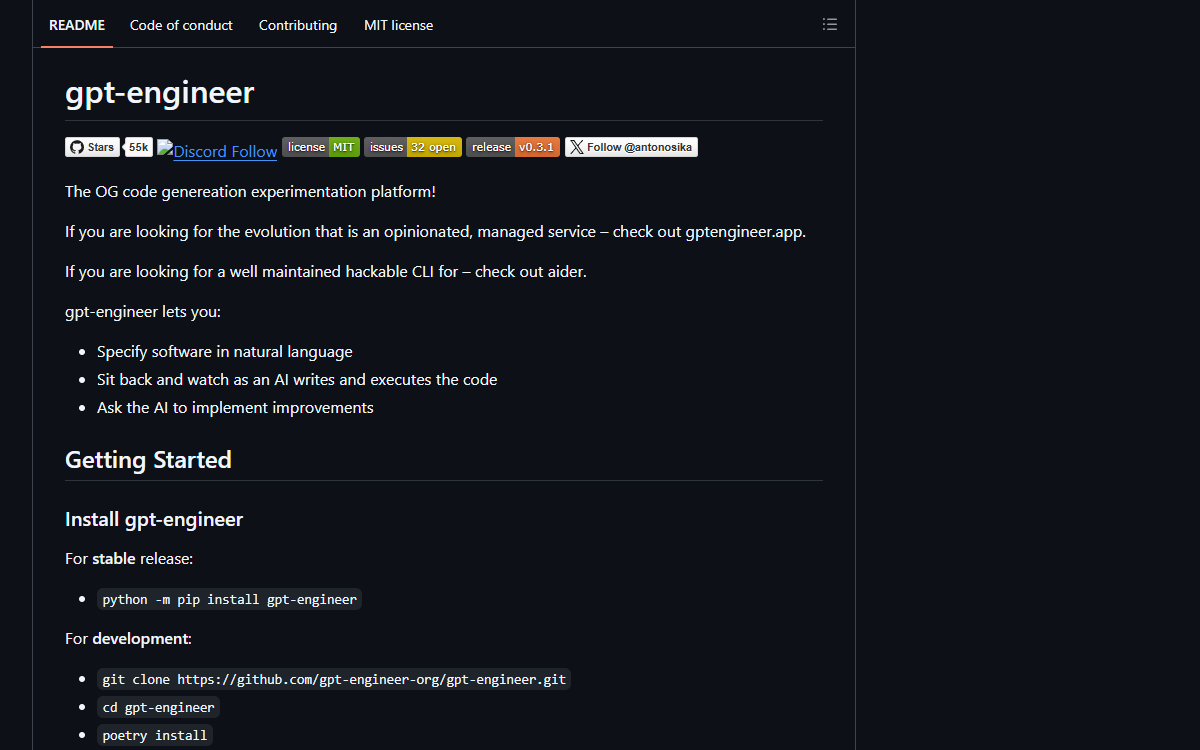
What it is
You put a plain-text prompt in an empty folder, ran one command, and got a codebase. The team behind it went on to build the commercial platform that became Lovable; the repository was archived on 22 April 2026, and its README now points users at gptengineer.app and aider instead.
Who built itAnton Osika is a Swedish engineer who co-founded the product-recommendation company Depict.ai and served as its CTO, before writing gpt-engineer in April 2023. Later that year he co-founded Lovable with Fabian Hedin; Lovable’s own note keeps the two apart, calling gpt-engineer the open-source command-line tool and gptengineer.app the commercial platform that took the Lovable name.
Build log
6 stages- 01
A seedling, in April 2023
The repository was created on 29 April 2023 and its first commit, “Seedling of our engineer is here”, is timestamped 12:53:21Z that day. Lovable’s own account of the project dates it to mid 2023; GitHub records the repository and the first commit on 29 April 2023. The first Hacker News thread appeared on 12 June 2023 and scored 3 points.
- 02
The Show HN that landed
The Show HN on 21 June 2023, “gpt-engineer – platform for devs to tinker with AI programming tools”, took 178 points and 53 comments. The first release, v0.0.2, had gone out on 18 June 2023. The usage pattern was a folder containing a plain-text file named prompt and one command, gpte <folder>; gpte -i modified existing code. The README also shipped bench, a tool for running your own agent implementation against the APPS and MBPP datasets.
- 03
From CLI to company
Lovable’s account says gpt-engineer became the fastest growing code repository on GitHub to date and passed 50,000 stars; that claim is the company’s own. A commercial web version, gptengineer.app, was built for non-technical users, and the company Lovable was founded in late 2023. Lovable’s note separates the two plainly: gpt-engineer is the open-source command-line tool, and gptengineer.app was the commercial web platform, later rebranded to Lovable to avoid confusion between them.
- 04
Development stops
The project produced 21 releases, the last being v0.3.1 on 6 June 2024. The last commit on the default branch is from 17 November 2024 and updates the README. At the collection date that was 678 days without a commit and 843 days without a release, with 107 contributors and 70 open issues.
- 05
Archived, with the README pointing elsewhere
GitHub shows the banner “This repository was archived by the owner on Apr 22, 2026. It is now read-only.” The README opens by sending readers to two other tools: gptengineer.app for an opinionated, managed service, and aider for a well maintained hackable CLI. It still calls the project “The OG code genereation experimentation platform”, spelling error included, and its badges point at gpt-engineer-org/gpt-engineer while the canonical repository is AntonOsika/gpt-engineer.
- 06
What the project turned into
gptengineer.app was rebranded to Lovable and moved to lovable.app; the company says existing projects and deployments were unaffected. On 18 December 2025, Sifted reported that Lovable had raised $330M at a $6.6bn valuation, with investment arms of Alphabet and Nvidia among the participants. The archived CLI is the precursor to that company, and the archive records it at 55,076 stars and 7,281 forks at the collection date.
Adjacent records
All records →No. 024
Codex CLI
OpenAI’s coding agent for the terminal, written in Rust after a rewrite from TypeScript.
No. 022
goose
A general-purpose AI agent that runs on your own machine, shipped as a desktop app, a CLI and an API, with extensions built on the Model Context Protocol.
No. 018
Cline
An open-source coding agent that reads files, runs terminal commands and edits across a repository.