Nuwa Skill
A skill that distils a person’s thinking — mental models, decision heuristics, the way they talk — into a reusable agent persona, and scores the result against a fidelity rubric before anyone else is allowed to use it.
What it is
The product is a thirty-eight-kilobyte instruction file. Given a name, it runs a research process across six dimensions — what the person wrote, how they spoke at length, their expression habits, criticism of them, their recorded decisions, and their timeline — produces seven traceable research documents, and writes a persona skill: mental models, decision heuristics, expression DNA, an explicit statement of its own limits, and a mechanism against drift. It is built on the open Agent Skills protocol and advertised as running in fifty-odd compatible tools. A community index collects personas other people have distilled, each carrying a fidelity scorecard.
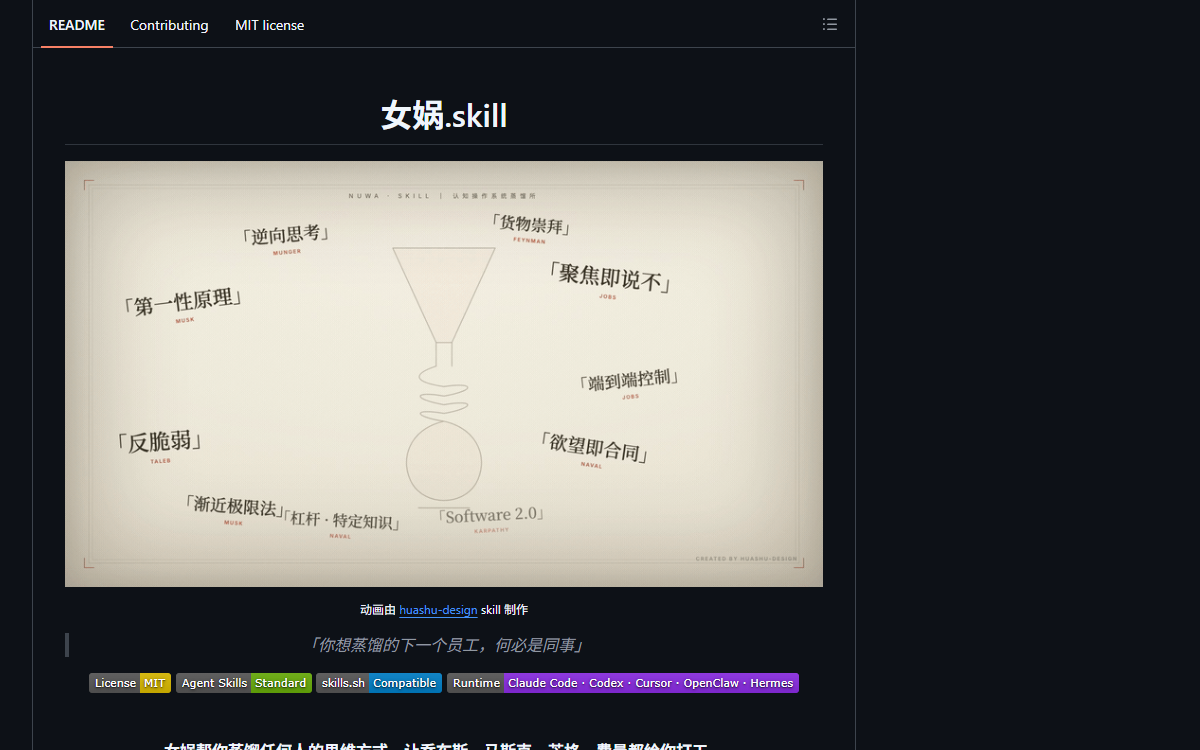
Who built itAuthor of 56 of the 58 commits, and the maintainer of the community index. He also maintains huashu-design, a separate skill of his own, which produced the animated banner at the top of this project’s README — one skill in his collection advertising another.
Build log
8 stages- 01
Thirty-three thousand stars for a thirty-eight-kilobyte instruction file
The repository is 38.6 megabytes and 159 files, and the thing it actually ships is
SKILL.mdat 38,280 bytes. The rest is research references, examples, promotion and animation. The history is 58 commits over five months, every one attached to a linked account, from three contributors of whom the author wrote 56. There are no releases and no tags. What it does have that most projects this size do not is five parallel READMEs — Chinese at seventeen kilobytes, Japanese at sixteen, Korean at fifteen, Spanish at fifteen, English at fourteen — which is a statement about where the audience is expected to be, and a reminder that this archive’s English-first reading of these projects is not the only one available. - 02
What it does
Give it a name and it researches the person and writes a skill that other agents can load. The README is unusually direct about the ambition: an earlier project proved that distilling a colleague is possible, so the argument runs, why distil a colleague — go distil Jobs, Munger, Feynman, Musk. The name is the Chinese creator goddess, which is the joke: she made people, and this makes people out of text. A sample exchange in the README has a distilled investor answer someone who says they want to start a media business, write a book and ship an independent product all at once, and the answer it produces is that all three are contracts with unhappiness, and the question is which one makes you forget the time. Whatever one thinks of the genre, that is a recognisable voice rather than a summary of one, and producing a recognisable voice from a corpus is the whole technical claim.
- 03
The interesting part is admitting a persona can be wrong
The most unusual file in the repository is the fidelity scorecard. A distilled persona is tested by an independent two-stage process in which one agent answers questions and a separate agent scores the answers, producing per-dimension results, an overall grade and the date of the test; community entries must reach seventy out of a hundred, a grade B, to pass the automated gate. Every skill must also carry an explicit section on its own honest boundaries and a chapter of anti-patterns. That combination is the right instinct and it is rare: the deliverable is not a prompt that claims to be a famous person, it is a prompt that ships with its own error bars and a stated list of the things it will get wrong. The obvious limit is also worth naming — the scorer is the same kind of model as the thing being scored, so a scorecard measures internal consistency much better than it measures whether the distillation is right.
- 04
The contribution gate is a bot, and the bot is specific
Adding a persona to the community index runs through an automated check that reports each condition separately: that the pull request changed only the index file; that the linked repository exists; that it contains a
SKILL.md; that the skill contains the honest-boundaries section; that it contains a references directory and, inside it, a research directory; that the fidelity score is at least seventy; and that the key fields of the scorecard contain no invented or estimated values. Only after all of that does the bot say the machine check passed, and add that the maintainer will still confirm the ethical red lines and spot-check the content by hand. Several things are worth copying here, and the most important is the last condition. Checking that a research trail exists, rather than trusting the summary of it, and refusing documents whose numbers are estimates, is a stricter standard than projects with a hundred times this repository’s reach apply to anything. - 05
Six dimensions, seven documents, on the record
The research half of the process is prescribed: six dimensions of enquiry producing seven documents, covering what the person published, how they spoke at length, their expression habits, criticism of them by others, their recorded decisions, and a timeline. The documents have to be self-contained and traceable, and at least one community entry notes that its evidence includes a first-hand video transcript supplied by the person making the submission. The reason to insist on the trail is simple and it is the same reason this archive keeps a sources line: a distilled persona is otherwise unfalsifiable. Every claim about how someone thinks would rest on the distillate looking right, which is precisely the judgement a reader cannot make without the underlying material.
- 06
One protocol, fifty runtimes
Distribution here works differently from the other persona collections in this archive. The project states that it is built on the open Agent Skills protocol and runs in more than fifty compatible tools — Claude Code, Codex, Cursor, OpenClaw, Hermes Agent, CodeBuddy, Workbuddy, Gemini CLI and OpenCode among them — with a compatibility badge for a skills registry. Where another roster in this archive converts its agents into thirteen target formats with its own pipeline, and paid for that with a conversion step that silently damaged a hundred and thirty-one files, this one is portable because a standard exists rather than because a converter was written. The difference shows up as an entire class of bug that this repository does not have.
- 07
A community of distilled people, and a written red line
The index collects what others have made: a financial commentator from a short-video platform, a psychology set covering Freud, Jung and Adler alongside a Chinese internet figure folded in as a pun on their names, and more arriving. Each entry carries its own fidelity grade, and the psychology set reports all four of its personas at grade A. The finance entry carries a disclaimer that it is not investment advice and cannot replace a professional, and the contributing guide names an ethical line for the repository. Distilling a living person’s way of thinking — or a dead one’s — raises a question about consent, accuracy and harm that most projects in this space simply do not address, and this one writes a rule down and puts it in the checklist rather than leaving it to taste.
- 08
What the repository cannot tell you
Fifty-eight commits, no releases and no tags, and a last commit five weeks before this record was written, with community pull requests still arriving and ten issues open. The repository is 38.6 megabytes, of which the instruction file is 38 kilobytes — the weight is animation, examples and promotion, which is a fair description of what a thirty-three-thousand-star project spends its bytes on. The fidelity scores come from the same family of models that do the distilling, so they are a consistency measure rather than an accuracy one. And the animated banner at the top of the README was made by another skill the same author maintains, which is either a delightful demonstration of the ecosystem or a small piece of self-promotion, and is honestly both.
Adjacent records
All records →No. 052
Distilly
A skill that turns a person’s messages, documents and interviews into a reusable profile — their experience, judgement and way of working — and states plainly that a profile is not a clone of the person.
No. 051
AI Job Search
A job-application framework that runs on your own machine: it scores postings against a profile you fill in, drafts a tailored CV and cover letter in LaTeX, compiles them, reads the rendered PDF back — and stops one step short of sending anything.
No. 048
gstack
Twenty-three specialist roles and eight power tools for Claude Code, all written as Markdown slash commands, plus the evaluation harness their author uses to decide whether any of it is working.