Ollama
Runs open-weight models on your own machine and serves them on a local API.
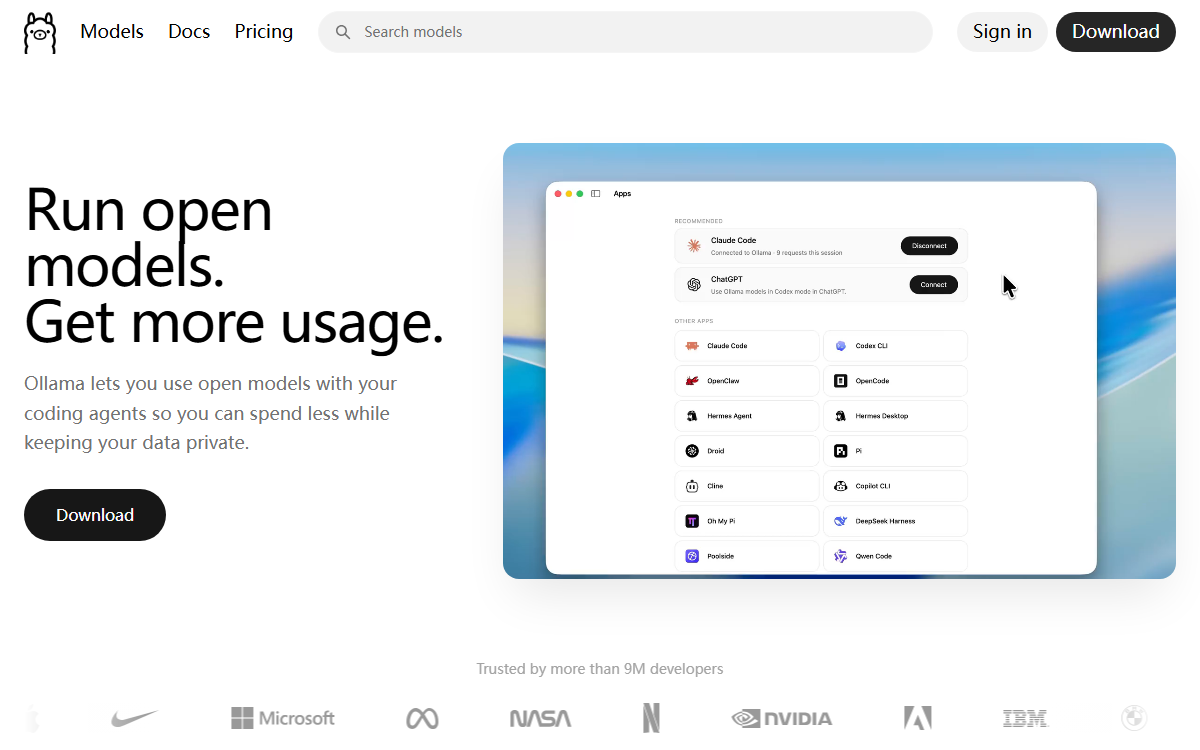
What it is
Downloads open-weight models and serves them from the user’s own machine, with Python and JavaScript libraries and an API that OpenAI and Anthropic clients already speak. The repository was created on 2023-06-26 and announced on Hacker News on 2023-07-20; the company now sells hosted inference alongside the local client.
Who built itOllama is run by two co-founders, CEO Jeffrey Morgan and Michael Chiang, who met at the University of Waterloo and built Kitematic, an open-source tool that made Docker easy to run and was acquired by Docker in 2015; their work on it became Docker Desktop. The repository went up under Morgan’s personal account in June 2023, and by July 2026 the company reported a team of fourteen, having moved its headquarters from Toronto to Palo Alto.
Build log
6 stages- 01
Two founders and an earlier tool
Jeffrey Morgan and Michael Chiang met at the University of Waterloo and built Kitematic, an open-source tool that made Docker easy to run, which Docker acquired in 2015; their work on it became Docker Desktop. In the company’s July 2026 post they described why they started Ollama: open models “were freely available to download, but it was hard to get them working. The power was there, but it wasn’t unlocked for developers who wanted to consume them the way they could access proprietary models behind an API.”
- 02
Repository on 2023-06-26, launch on 2023-07-20
The repository was created on 2023-06-26T19:39:32Z under the personal account `jmorganca`, with the first commit the same day, “move prompt template to server”. Version v0.0.1 was tagged on 2023-07-08, and the public launch was a Show HN post on 2023-07-20 — “Show HN: Ollama – Run LLMs on your Mac”, 284 points and 94 comments — pointing at `github.com/jmorganca/ollama`. The repository moved to `ollama/ollama` between July and September 2023.
- 03
From macOS to every platform
Linux support arrived with v0.1.0 on 2023-09-26 and an official Docker image on 2023-10-06. Python and JavaScript libraries followed on 2024-01-25, the Windows preview on 2024-02-17, and AMD GPU support on 2024-03-15. Later additions include tool calling (2024-08-19), structured outputs (2024-12-07), Web Search (2025-09-25) and an MLX backend on Apple Silicon, in preview, on 2026-03-31.
- 04
The registry moves from ollama.ai to ollama.com
Pull request #2483, opened 2024-02-14, describes the change: “update default registry domain from registry.ollama.ai to ollama.com — migrate models by moving models to their new location. this is one directional”. The old domain appears in an official blog link as late as 2024-01-25 and the new one as early as 2024-02-17. The pull request’s own `merged_at` field is null.
- 05
A licence dispute with llama.cpp
On 2025-05-16 a Hacker News thread titled “Ollama violating llama.cpp license for over a year” (202 points, 68 comments) pointed at repository issue #3185, whose title is “ollama doesn’t distribute notice licenses in its release artifacts”. The project published a post the same day titled “Ollama’s new engine for multimodal models”.
- 06
$88M, cloud pricing, and the repository today
On 2026-07-09 the company announced $88M raised in total, from Peter Fenton at Benchmark, Tomasz Tunguz at Theory Ventures, Alex Kolicich at 8VC, Docker founder Solomon Hykes and others; BetaKit and TechCrunch reported the most recent round as $65M led by Theory Ventures, and BetaKit put the team at fourteen people with the headquarters moved from Toronto to Palo Alto. The same post gives 8.9 million developers and 85% of the Fortune 500, both company-reported figures with no published method. On 2026-08-31 the cloud tier moved to published token pricing — Pro at $20/month with $60 of usage, Max at $100/month with $300, Team at $500/month with $1,000 of shared usage and no seat limit — running in the United States and Europe, with some Qwen models in Singapore, and the company states that it does not log prompts or train on user data. At the 2026-09-27 snapshot the repository had 181,809 stars, 18,024 forks, 615 contributors and 4,115 open issues, with the last commit on 2026-09-26; the newest release, v0.40.0-rc0 on 2026-09-25, is a release candidate rather than a stable version, and the 256 releases counted by the API exclude untagged commits.
Adjacent records
All records →No. 039
classic-vibe-mac
Write C in a browser tab, press Build & Run, and a System 7 Macintosh boots with your freshly compiled 68k application sitting on its desktop.
No. 022
goose
A general-purpose AI agent that runs on your own machine, shipped as a desktop app, a CLI and an API, with extensions built on the Model Context Protocol.
No. 009
Open Interpreter
A terminal coding agent that started as a local alternative to OpenAI Code Interpreter and was rebuilt in 2026 as a Rust fork of Codex, aimed at open-weight models.