
SimpleEnglish
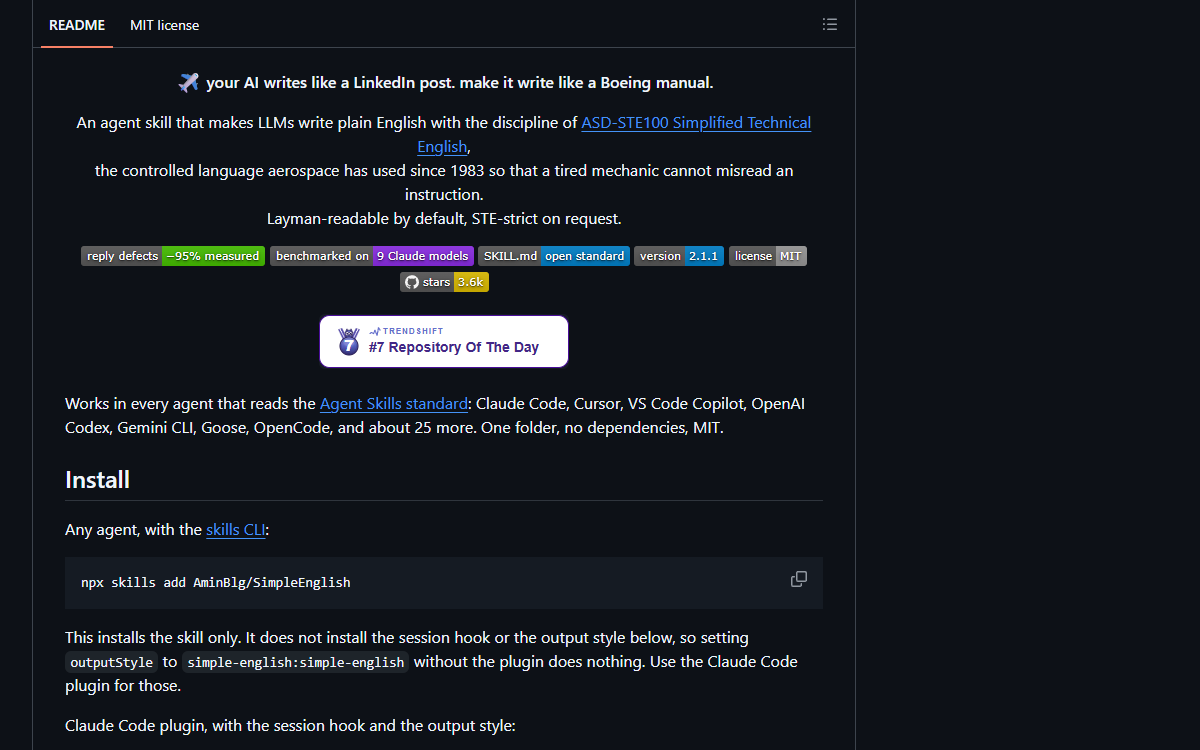
An agent skill that makes a model write plain English under ASD-STE100 Simplified Technical English, the controlled language aerospace has used since 1983, with layman-readable as the default and STE-strict on request.
GitHub avatar of AminBlg, not the project’s own logo — taken from github.com on 2026-10-02.
What it is
SimpleEnglish is a skill for coding agents that puts their prose under ASD-STE100 Simplified Technical English — the controlled language aerospace has used since 1983 so that a tired mechanic cannot misread an instruction. It is layman-readable by default and STE-strict on request, ships as a SKILL.md under the Agent Skills open standard, and carries its own benchmark: the README claims 95% fewer visible reply defects, measured on nine Claude models, with the results checked into the repository.
Who built itThe repository’s 86 commits come mostly from the maintainer under two names — AminBlg on 59 and Amin Boulegroun on 11 — and thirteen other people contribute the remaining sixteen, one or two commits each. Version 2.1.1 of the skill is what the README documents.
How it is put together
The parts · 4The shape is a skill plus an evaluation, with neither treated as the lesser half. One SKILL.md carries the rules and the two registers; a directory of results carries the evidence that the rules change what comes out; and the README argues the case and links into both. The standard is external and public, which is what lets the rules be checkable rather than a house style — ASD-STE100 is a published specification with its own vocabulary and sentence-length limits.
- skills/simple-english/SKILL.md
- The skill: the rules, the two registers — layman-readable by default, STE-strict on request — and the version the README badges.
- evals/
- Eleven files and 79 KB of evaluation scripts that produced the results directory, including the rebuild that the headline number comes from.
- evals/results/
- 814 files and 818 KB — the overwhelming majority of the repository by file count. The dating matters:
rebuild-2026-09-02/RESULTS.mdis what the 95% badge points at. - README.md
- The claim, the badges that link to the evidence, and the reason the standard was chosen: an aerospace controlled language written so a tired mechanic cannot misread an instruction.
Choices, and what they beat
Adopt a published external standard instead of inventing a house style over a list of writing rules written for this project
ASD-STE100 is a specification with a fixed vocabulary and sentence-length limits, which makes compliance something a reader can check rather than something the skill asserts about itself.
Keep layman-readable as the default and STE-strict as an option over applying the strict controlled language everywhere
The standard was written for procedural maintenance text; the README states the default as the readable register so the skill is usable for ordinary documentation too.
Check 800 KB of evaluation results into the repository over reporting the headline number in the README alone
The README’s main claim is a measured reduction in reply defects on nine models, and the badge links to a dated results file rather than restating the figure.
Read fromREADME, the repository tree and evals/results of AminBlg/SimpleEnglish, read 2026-10-02.
Build log
4 stages- 01
A rulebook borrowed from aerospace, and a benchmark to hold it to
The repository was created on 2026-07-21 and its last push is 2026-09-30, with 86 commits across those three months — twelve in July, twenty-four in August, fifty in September. The README opens with the comparison the project is built on: aerospace has written instructions in ASD-STE100 since 1983 so that a tired mechanic cannot misread them, and the skill applies the same discipline to what a model writes. Version 2.1.1 is current, the skill is MIT-licensed, and the installation target is
skills/simple-english/SKILL.mdunder the Agent Skills standard rather than a specific vendor. - 02
The claim is measured, and the measurement is in the repository
Of 854 files, 814 are under
evals/results— 818 KB of results against 79 KB for the evaluation scripts themselves and five files for the skill. That ratio is the point: the README’s headline number, a 95% reduction in visible reply defects, is not an assertion but a directory, and it is dated — the badge links toevals/results/rebuild-2026-09-02/RESULTS.md, so a reader can see which rebuild produced it. A second badge states the benchmark covers nine Claude models, and a third points at the skill file itself. - 03
Two registers, one skill
The project does not force the strict form on every use. The README states the default as layman-readable, with STE-strict available on request, which is what makes it usable for ordinary documentation rather than only for the procedural text the standard was written for. The rules live in one
SKILL.md; the README’s job is the argument for why a model should follow them, and the evaluation’s job is whether it did. - 04
Six commits out of eighty-six carry a model’s name
Six commits carry a co-author trailer and all six name a Claude model — Opus 5 twice, Fable 5 twice, Opus 5 (1M context) once and Sonnet 5 once. Against a repository whose product is a rulebook and a benchmark, that is a small share, and it is the honest one to report: this is a project written mostly by hand whose releases and fixes were partly written with a model, in the same way its own README asks other people’s text to be.
Adjacent records
All records →No. 139
AntOmniEvo
A Python framework that runs an evolution loop over a directory of your files: a coding agent rewrites them from the failure trajectories of the previous candidate, parent and child are scored on the same training batch, and only an improvement that clears a threshold is re-scored on the validation set and kept.
No. 131
agent-memory
A long-term memory runtime for AI agents that keeps plain Markdown files as the single source of truth, ranks them locally without calling a model, answers recall with file paths the agent opens one level at a time, writes at conversation boundaries rather than on the agent’s initiative, and runs an independent sleep-time layer that may add and update on its own but can only ever file a deletion as a proposal — one store shared by Claude Code, Codex CLI and Hermes, with no API key.
No. 125
sepia
A portable de-AI writing skill: four operations over one canonical rules file, narrative architecture repaired before word choice on fiction, a thin rule file matched to the venue on professional prose, and every rule labelled as measured, consulted or the project’s own inference.