Clawd on Desk
A pixel crab that sits on your desktop and shows what your AI coding agent is doing, so you can walk away from a long task.
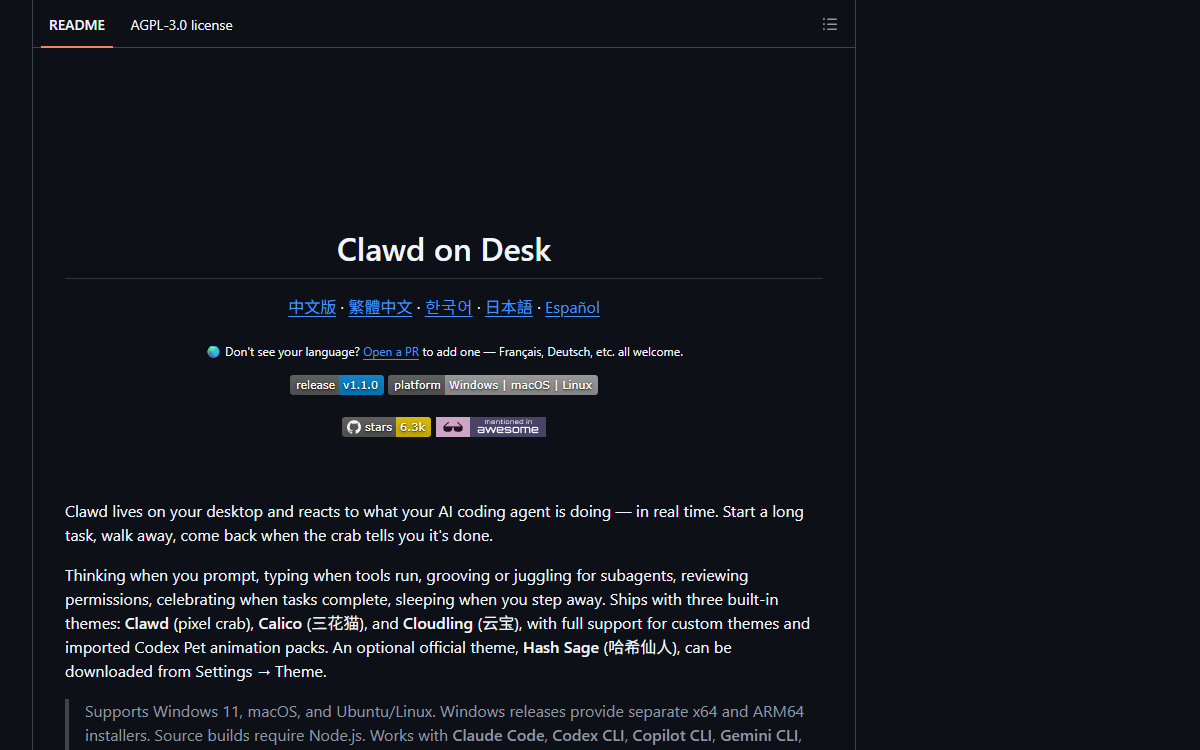
What it is
A desktop pet for people who run coding agents. Clawd reads what your agent is doing and plays a matching pixel animation: thinking while the model reads the codebase, typing while tools run, juggling when several subagents are going, raising a card when a permission prompt appears, and celebrating when the task finishes. It ships as an Electron app for Windows, macOS and Linux and integrates with twenty-seven different agents, from Claude Code and Codex CLI to DeepSeek Harness.
Who built itA solo developer working under the handle rullerzhou-afk, also shown in commits as Ruller_Lulu — about three quarters of the last hundred commits are theirs. The project has since drawn 118 contributors, most of them wiring up additional coding agents rather than working on the animations.
Build log
6 stages- 01
The problem is that you keep coming back to check
A long agent task turns a developer into a polling loop: switch to the terminal, see nothing finished, switch back. Clawd replaces the checking with a glance. Its own site puts it as “a little company for your coding day” — the pet is ambient status, not a dashboard, and the intended use is starting a long task and leaving the desk.
- 02
How it finds out what the agent is doing
There is no single integration, because the agents do not agree on anything. Claude Code is read through command hooks plus HTTP permission hooks; Codex CLI uses its official hooks with a JSONL fallback that polls session files; opencode and MiMo Code are read through their plugin SDKs; Pi and OMP through global extensions. Some agents expose a blocking permission hook, so Clawd can put Allow and Deny on screen; others only report state, and the choice stays in the agent’s own terminal.
- 03
Twenty-seven integrations, and the differences matter
The README documents each agent separately rather than claiming uniform support, because the same word means different things in each. Antigravity CLI is state-only — Clawd never shows a permission bubble for it. WorkBuddy resolves permissions inside its own native sandbox, so no permission hook is registered at all. Kiro CLI gets an auto-created agent profile re-synced from the built-in default, so opting in does not change behaviour elsewhere. That per-agent care is why the project has 118 contributors: most arrived to add one more.
- 04
The animations are a state machine
The pixel art is driven by agent lifecycle events rather than being decorative. Sleeping, thinking, typing, error, attention and sweeping are distinct states; subagent activity fans out into either one agent grooving or several juggling. Three themes ship in the box — a pixel crab, a calico cat and a cloud — with a fourth, Hash Sage, downloadable, and custom themes and imported Codex Pet animation packs supported. The interface is translated into English, both Chinese scripts, Korean, Japanese, Portuguese and Spanish.
- 05
Written with coding agents, and it says so
The repository carries a CLAUDE.md and a 46,000-character AGENTS.md, the instruction files coding agents read when working in a codebase — the second is explicitly the entry point for agents, with architecture kept separately in docs/project. One commit in the last hundred carries a Co-Authored-By: Claude Code trailer; the rest are unattributed, which is the normal case since the trailer is opt-in. The tool that watches coding agents is itself maintained by them.
- 06
Six months from nothing to 1.1
The repository and its first release both date from 18 March 2026, and version 1.0.0 arrived on 4 September, followed by 1.1.0 on 19 September. Thirty-eight releases and about 2,500 commits in six months, with Windows x64 and ARM64 installers built separately. It is AGPL-3.0 and had 6,318 stars and 658 forks at the end of September 2026. Coverage is thin outside GitHub — the one Hacker News submission found scored a single point — so the growth came through the repository and word of mouth rather than a launch post.
Adjacent records
All records →No. 039
classic-vibe-mac
Write C in a browser tab, press Build & Run, and a System 7 Macintosh boots with your freshly compiled 68k application sitting on its desktop.
No. 030
Vibe Prolog
A Prolog interpreter written by AI agents under an explicit no-human-code rule — and an unusually clear-eyed report on how that went.
No. 029
realworld-vibe-coded
A full-stack RealWorld implementation whose real subject is the harness around it: thirty-two custom Roslyn analyzers, one build entry point, and hooks that stop an agent from doing the wrong thing.