Dify
A visual workspace for building agentic workflows and RAG pipelines, run from Docker or from the vendor’s cloud.
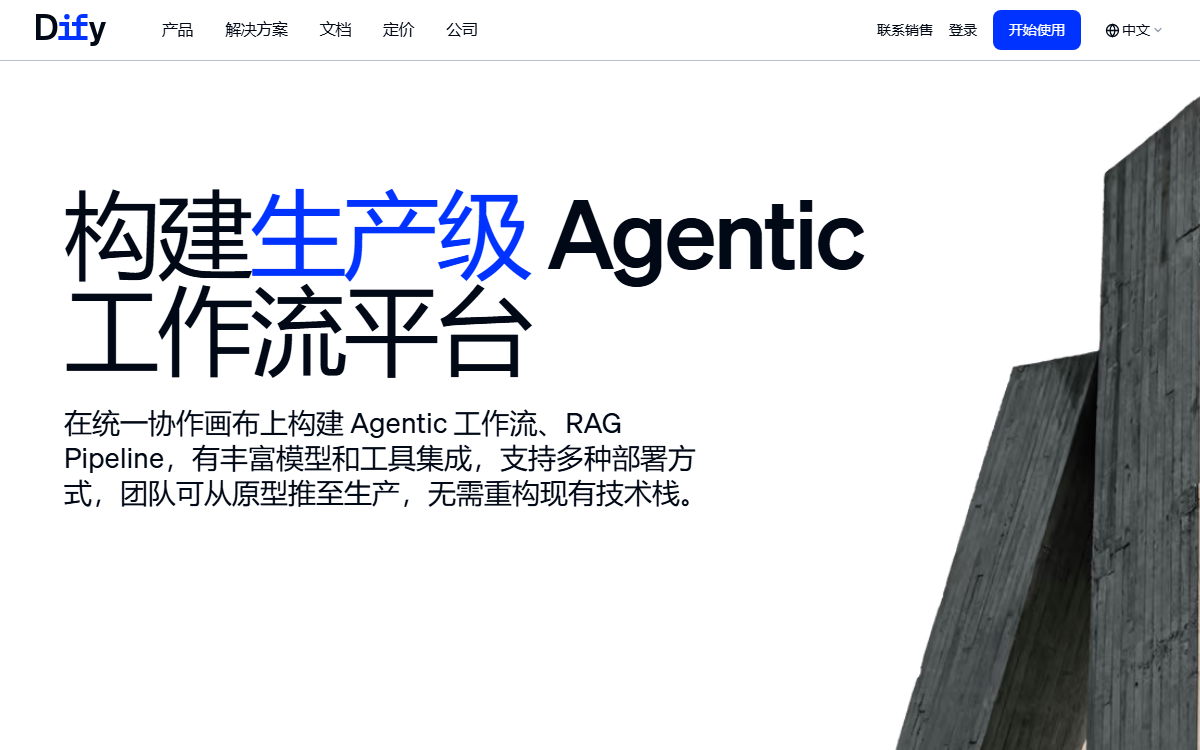
What it is
A visual workspace for building agentic workflows and RAG pipelines, deployable on the vendor’s cloud, in a VPC, or from Docker on your own machines. The source is public but the licence is not plain Apache-2.0 — it adds conditions Apache-2.0 does not have, including no multi-tenant service built on the source without written authorisation and no removing the Dify logo or copyright notices from the frontend — and GitHub reports it as NOASSERTION rather than as a standard OSI licence.
Who built itThe builder of record is LangGenius, Inc., the operating company — a US entity with headquarters in Menlo Park — behind a four-founder team. The CEO is Luyu Zhang and the COO Pan Huiyan, and China work is handled by a separate registered entity in Suzhou, established on 2023-03-23. The company raised a $30M Series Pre-A in March 2026 and said in April 2026 that it had around 100 employees.
Build log
6 stages- 01
Deciding to build it, and the first commit
The co-founder and COO, Pan Huiyan, dates the decision to the end of February 2023 and the first version to early May, describing the team as having caught a large window that existed at the time. The founding team was four people covering engineering, product, operations and commercialisation, and the wider early team was about a dozen, all of them former colleagues, with a DevOps tooling background; the earliest work was remote and part-time. The framing they put in front of the product was LLMOps — helping developers apply model capability and keep operating and iterating on it. The reason for starting was specific: GPT had arrived, and their own engineers, already strong by the team’s own description, still needed at least two weeks to understand it and build a toy, so they expected it to be harder for everyone else. The name is a compound rather than an ordinary English word — Define plus Modify, and, read as an abbreviation, Do it for you. The GitHub organisation langgenius was created on 2023-03-07 and the repository on 2023-04-12; the first commit, “Initial commit”, landed on 2023-05-15 under the account takatost, and the earliest release on GitHub is 0.2.1, published the same day — there is no 0.1.x in the release list. The repository opened with a small group: takatost made 17 commits in the early stretch, iamjoel 6, crazywoola 3, killpanda 2, and zxhlyh and Panmuse 2 each.
- 02
Show HN, and the first year as an LLMOps tool
The first public post was a Show HN on 2023-05-24 from the user pinkbanana — “Dify.ai – Open-source platform for LLMOps, define your AI-native apps” — pointing at dify.ai and scoring 4 points with 1 comment. The poster described an open-source LLMOps platform with visual management of prompts, operations and datasets and apps creatable in minutes; the product’s own description at that point was visual prompt orchestration, operations and dataset management. Twelve months in, the company reported more than 30,000 stars and more than 400,000 installs worldwide.
- 03
From prompt orchestration to agentic workflows, and 1.0
In June 2024 the founder wrote that the year’s main product was Dify workflow, a development framework trading ease of use against flexibility, and the repository description now leads with agentic workflows and RAG pipelines. Version 1.0.0 was published on 2025-02-28, about 21 months after the first release, adding plugins, a marketplace, a new agent node and reworked RAG and memory. Two Hacker News posts followed, on 2025-03-01 and 2025-03-03, at 2 points and 1 point.
- 04
The licence is not plain Apache-2.0
The licence file is titled “Open Source License” and opens by saying Dify is licensed under a modified version of the Apache License 2.0 with additional conditions. Commercial use is allowed, including as a backend service for other applications or as an application development platform for enterprises. The added conditions are that you may not use the Dify source code to operate a multi-tenant environment without written authorisation, where one tenant corresponds to one workspace, and that in the frontend you may not remove or modify the logo or copyright information in the Dify console or applications — the frontend being every component in the web/ directory when running from raw source, or the web image when running with Docker, with uses that do not involve the frontend exempt. Contributors are asked to agree that the producer may make the open-source agreement stricter or looser as it sees fit, and that contributed code may be used commercially, including in cloud business operations. The file also states that the interactive design is protected by an appearance patent and carries the notice “© 2025 LangGenius, Inc.”; outside those conditions the terms are Apache-2.0. GitHub reports the repository licence as NOASSERTION rather than as one of the standard OSI licences. On 2025-10-15 a developer, Moming Duan, posted the terms to the OSI license-discuss list, writing: “I think these additional terms may conflict with OSD6 and would appreciate the community’s comments on this issue.”
- 05
Three product lines, three entities, four cities
The product ships in three forms: Community Edition, self-deployed with Docker; Dify Cloud, the hosted version; and Dify Enterprise, private deployment for enterprise teams. The operating company is LangGenius, Inc., in the United States with headquarters in Menlo Park; a Japanese entity, LangGenius K.K., was established on 2025-02-05 in Nihonbashi, Tokyo; and the company’s own About page lists four cities — Menlo Park, Tokyo, Suzhou and Shanghai. In China there is a separate registered entity in Suzhou, established on 2023-03-23, with Luyu Zhang as its legal representative.
- 06
$30M, and the numbers at the 2026 snapshot
On 2026-03-10 a post signed by founder and CEO Luyu Zhang announced “a $30M Series Pre-A round led by HSG, with participation from GL Ventures, Alt-Alpha Capital, 5Y Capital, Mizuho Leaguer Investment and NYX Ventures”; Chinese company databases record four rounds starting 2023-03-23 and put cumulative disclosed funding at 203 million yuan, and two funding databases put the March 2026 valuation at $180 million. The same announcement reported Dify running on more than 1.4 million machines, used by 2,000+ teams and 280+ enterprises across 175+ countries, and quoted Maersk and ETS by name. At the 2026-09-27 snapshot the repository had 157,336 stars, 24,797 forks, 1,511 contributors and 1,132 open issues, with 170 releases and 1.17.1 published on 2026-09-10.