
i-have-adhd
A ten-rule skill for coding agents that puts the next action first, numbers multi-step work, caps lists at five and ends every reply with one concrete next step.
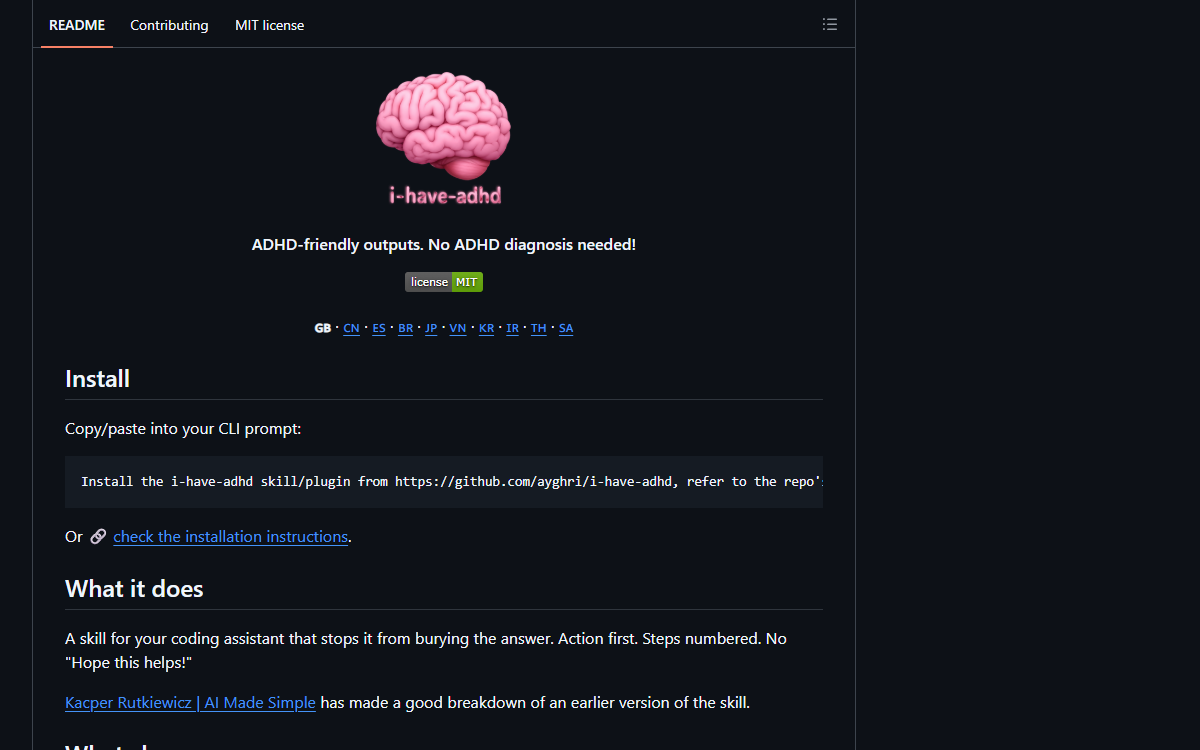
GitHub avatar of ayghri, not the project’s own logo — taken from github.com on 2026-10-02.
What it is
A skill for a coding agent that changes how it reports back rather than what it can do. Ten rules: lead with the next action, number multi-step tasks, end with one concrete next step, suppress tangents, restate state every turn, give time estimates in minutes, make wins visible, report errors matter-of-factly, cap lists at five, and open with no preamble. It installs as a Claude Code plugin from the marketplace, and the README says it is loosely based on The Adult ADHD Tool Kit.
Who built itThe repository’s 245 commits come from around fifty people. The maintainer has the largest share under two commit names — Ayoub Ghriss on 73 and Ayoub G. on 53 — followed by ayghri on 15, thejesh23 on 15, Lynn! on 8, Benziza on 5 and Jonathan Abraham on 5, with the rest contributing one to three commits each. The repository carries translations of its README into ten languages.
How it is put together
The parts · 3One Markdown file is the product. Everything else in the repository — the translations, the tests, the maintainer’s own notes — exists to distribute or check that file. The rules are ordered around a single promise rather than a style preference: the reader should never have to scroll to find out what to do next, so the action comes first, the steps are numbered, and the reply ends with one next step rather than a summary.
- skills/i-have-adhd/SKILL.md
- The skill: ten rules with their full text. The README lists the rule names and defers to this file for the wording, so the two cannot drift into two different rulebooks.
- The plugin packaging
- Installation through the host assistant’s marketplace rather than a copy step — add the marketplace, install the plugin, restart, re-invoke. The README notes that a fork and the upstream share a name, so the upstream copy has to be removed first.
- tests/ and .github/install/
- Eight test files and an eight-file install directory, 215 KB, in a repository whose product is 73 files of prose and configuration — the checks are a substantial part of the repository by size.
Choices, and what they beat
Adapt a human organisational method instead of inventing a house style over writing a fresh list of formatting rules
The credits name the source and the adaptation explicitly: The Adult ADHD Tool Kit, changed from how a person should organise their day to how a model should answer.
Keep the rules in the skill file and list only their names in the README over restating the ten rules in full in the documentation
The README prints the titles and says the full text lives in
SKILL.md. A rulebook that exists twice is a rulebook that disagrees with itself the first time one copy is edited.
Read fromREADME, INSTALL.md and the repository tree of ayghri/i-have-adhd, read 2026-10-02.
Build log
4 stages- 01
A style rulebook that ships as a plugin, not a prompt
The repository was created on 2026-05-13 and holds 73 files: the skill itself, ten README translations, eight test files and an install directory. The product is one
SKILL.mdunderskills/i-have-adhd/, and the README states the whole of it — ten rules, from lead with the next action to no preamble, no recap, no closers — with the full text kept in that file rather than restated in the documentation. Installation goes through the host’s own plugin system rather than a copy step: the marketplace is added, the plugin installed, the assistant restarted and the skill re-invoked. - 02
The before-and-after is the argument
The README’s main section is a two-column table: on the left a typical assistant reply that opens with a paragraph of framing and buries the fix, on the right the same answer under the skill — the file, the line range, the snippet, the command to run, and one line naming what to paste back if it fails. The credits say the rules come from The Adult ADHD Tool Kit by J. Russell Ramsay and Anthony L. Rostain, adapted from how a person should organise a day to how a model should answer.
- 03
Two hundred and forty-five commits, mostly from other people
The history runs from 2026-05 to 2026-09 with the work concentrated in July (110 commits), August (67) and September (59). Around fifty commit names appear; the maintainer’s two accounts hold 126 of the 245, and the remainder is spread thin — fifteen from one contributor, eight from another, and a long tail of one- to three-commit contributions. That distribution, rather than the star count, is what the README’s translation set reflects: ten languages maintained by people who are not the author.
- 04
What the trailers say about how it was written
Twelve of the 245 commits carry a co-author trailer, and eleven name an AI system: Claude Opus 5 (1M context) four times, Claude Opus 4.8 (1M context) three, Claude Opus 5 twice, Claude Fable 5 once, and Copilot Autofix powered by AI once. The twelfth names a person. The share is small next to the contribution count, which is the honest reading of this repository: it is a community project whose releases and automated fixes were partly written with a model, not a model-written project.
Adjacent records
All records →No. 140
typesafe-computer-use
It drives a Mac toward a goal typed in plain English: OCR and the accessibility tree read the screen, a TypeSafe classifier picks the next action, and a writing model runs only for free text. A decision costs about $0.0002, a fiftieth of a cent, against $0.032 for a frontier model reading the same screenshot.
No. 139
AntOmniEvo
A Python framework that runs an evolution loop over a directory of your files: a coding agent rewrites them from the failure trajectories of the previous candidate, parent and child are scored on the same training batch, and only an improvement that clears a threshold is re-scored on the validation set and kept.
No. 138
DSCODE
A macOS terminal coding agent built on DeepSeek Harness, carrying its own pinned harness profile, a terminal package it patches at build time, and a session layer — sessions that message each other, Ultra sub-agents, reviewed approvals, scheduled runs.