
Kev
A family of small decision models built on Qwen3.5/3.8 that answer narrow questions with calibrated probabilities, trained and run on hardware you own — and 134 of its 333 commits carry Devin’s name.
GitHub avatar of jaredpalmer, not the project’s own logo — taken from github.com on 2026-10-02.
What it is
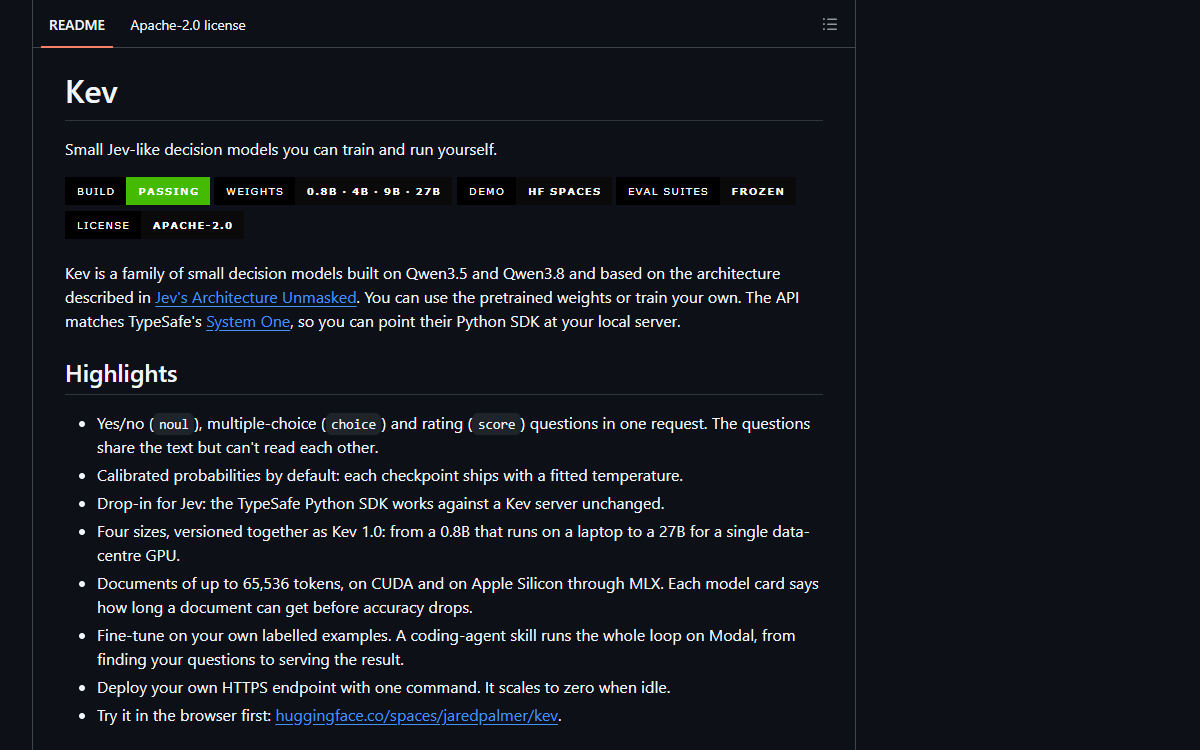
Kev is a family of small decision models built on top of Qwen3.5/3.8 that you train and run yourself, aimed at the narrow questions an application asks over and over rather than at open-ended generation. The repository carries its own evaluations — evals/round5 and evals/devtools-v1 at 14.6 MB and 12 MB — alongside 22 KB of notes on automated research, in a tree of 3,049 files that is mostly run artefacts rather than library code.
Who built itThe repository’s 333 commits are almost entirely his — Jared Palmer on 312, the Devin integration bot on 12 — with a single commit each from eight other people. 145 commits carry a co-author trailer and 134 of them name Devin: 127 as Devin, six as Devin AI and one as the integration bot. The remaining eleven name people or a Claude model.
How it is put together
The parts · 4The work is organised as rounds rather than as a library. Each round is a directory holding its own evaluation data, results and runs, so a change in the recipe is measured against the previous round instead of against a moving baseline. The models themselves are small enough to be trained locally on top of Qwen3.5/3.8, and the repository keeps the research notes — 22 KB of them — next to the artefacts they produced.
- evals/round5
- Nine files and 14.6 MB — the evaluation data and results of the fifth round, the largest single directory in the repository.
- evals/devtools-v1
- Four files and 12 MB for the developer-tools evaluation, kept as its own versioned set rather than folded into a shared test harness.
- runs/r5-combined
- The run outputs behind round five — a project sixteen days old that already keeps per-round run artefacts rather than a single result file.
- docs/autoresearch.md
- 22 KB of notes on the automated research loop, sitting next to the artefacts that loop produced.
Choices, and what they beat
Keep every evaluation round as its own directory over one test suite overwritten each time
The tree holds round-five data at 14.6 MB beside a separate devtools evaluation at 12 MB, so a result can be compared with the round before it after the fact.
Train small models for narrow decisions over prompting a large model for every call
The README frames the family as models you train and run yourself, which places the cost at training time rather than at every request.
Build on Qwen3.5/3.8 rather than from scratch over a bespoke base model
Stated in the one-line description: the family is built on top of those bases, so the work is the decision task and the training recipe rather than the foundation model.
Read fromREADME, docs/autoresearch.md and the repository tree of jaredpalmer/kev, read 2026-10-02.
Build log
3 stages- 01
Three hundred and thirty-three commits in sixteen days, most of them Devin’s
The repository was created on 2026-09-17 and has been pushed to every day since: 333 commits, of which 322 landed in September and eleven in the first days of October. The authorship is the part worth reading first. 145 commits carry a co-author trailer and 134 name Devin — 127 as Devin, six as Devin AI, one as the integration bot — against eleven naming a person or a Claude model. Jared Palmer holds 312 of the 333 commits himself. The reading is not ambiguous: this is one person directing an autonomous agent through a fast research loop, and the trailer is the record of it.
- 02
A repository shaped like a series of experiments
Of 3,049 files, the largest directories are results rather than code:
evals/round5at nine files and 14.6 MB,evals/devtools-v1at four files and 12 MB, andruns/r5-combinedbehind them. A tree that size, in a project sixteen days old, is what an iterative evaluation loop leaves behind — each round keeping its measurements rather than overwriting them, so a comparison between rounds is possible after the fact. The documentation concentrates in one place:docs/autoresearch.mdat 22 KB. - 03
What it is for, and what it refuses to be
The README’s one-line description is narrow on purpose — small decision models you can train and run yourself, built on Qwen3.5/3.8 — and the name it reaches for situates it against a known shape: a Jev-like family. The emphasis is on owning both ends: the training and the running happen on hardware the reader has, which is the same position several other records in this batch take, arrived at from the opposite direction — not by shrinking a large model’s runtime, but by training small models for questions that do not need one.
Adjacent records
All records →No. 142
Jeff
A 0.8B open System 1 model with swappable LoRA adapters that makes the quick decisions in front of a large local model, answering first and passing the query on only when it is unsure.
No. 131
agent-memory
A long-term memory runtime for AI agents that keeps plain Markdown files as the single source of truth, ranks them locally without calling a model, answers recall with file paths the agent opens one level at a time, writes at conversation boundaries rather than on the agent’s initiative, and runs an independent sleep-time layer that may add and update on its own but can only ever file a deletion as a proposal — one store shared by Claude Code, Codex CLI and Hermes, with no API key.
No. 128
Easel
An open-source content workbench for social media creators: one agent runs the whole loop — aggregate the hot lists, plan a topic, generate the copy, the cards, the voice and the video, publish the finished file to an account that is already logged in on seven Chinese platforms, then read the numbers back into the account profile that shaped the next round.